Giuseppe di Stefano: The Opera Singer
Recorded: 5–6 June, 1957, Milan
Giuseppe di Stefano (tenor) & Rosanna Carteri
Milan Symphony Orchestra, Antonio Tonino
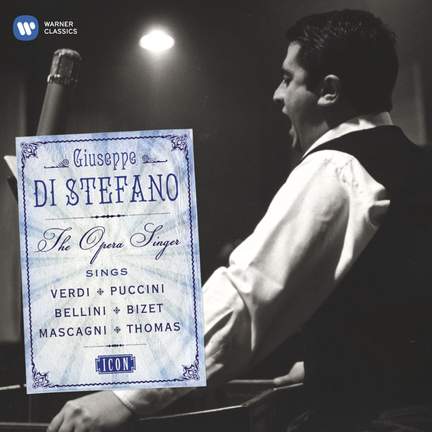
Giuseppe di Stefano: The Opera Singer
Recorded: 5–6 June, 1957, Milan
Giuseppe di Stefano (tenor) & Rosanna Carteri
Milan Symphony Orchestra, Antonio Tonino
Purchase product

About
The Italian tenor Giuseppe di Stefano, who died on 3 March 2008 aged 86, was one of the finest opera singers of his day. He was blessed with a lyric tenor voice of great beauty, as well as a bright, open tone, and possessed the ability to bring vividly to life the characters he played, both on stage and in the recording studio. He began his career in lighter roles like Nemorino in L’elisir d’amore, but later graduated to heavier parts such as Alvaro in La forza del destino and Canio in Pagliacci. He first appeared at La Scala in March 1947 as Des Grieux in Massenet’s Manon, and in February 1948 he made his New York debut at the Metropolitan Opera as the Duke of Mantua in Rigoletto. In the same year he was also heard for the first time in Rio de Janeiro, Mexico City, Los Angeles, San Francisco and Chicago, and he went on throughout the 1950s to enjoy a career of uninterrupted success, centred mainly on La Scala and the Met.
He recorded extensively for EMI for the first decade or so of his career, and after making several recordings of popular songs in 1944 in Lausanne, he consolidated his position as a recording artist in the years that followed with a series of operatic arias and Italian folksongs in London and Milan, as well as some titles for RCA Victor in New York. In 1953, the EMI producer Walter Legge teamed Di Stefano with Maria Callas and Tito Gobbi in a recording of Lucia di Lammermoor in Florence and then went on during the next five years to make a series of unrivalled recordings of Italian operas with the same artists at La Scala. They remain to this day the benchmark against which all subsequent recordings of the same works are judged, and the 1953 Tosca conducted by Victor de Sabata is now generally acknowledged to be one of the finest recordings ever made. Di Stefano also appeared in several of Callas’s greatest stage successes at La Scala, including the 1954 Lucia di Lammermoor under Herbert von Karajan and the 1955 Traviata under Carlo Maria Giulini: live recordings of both are also available on EMI.
In the early 1950s, when the operatic catalogue of EMI was led by three of the greatest sopranos of the time – Maria Callas, Victoria de los Angeles and Elisabeth Schwarzkopf – it was Giuseppe di Stefano who carried the banner for tenors, and he did it with great style. All his recorded performances capture not only his glorious voice, but also his outgoing and exuberant personality, which made him so popular both on stage and off. Like Callas, his glory days were relatively short, but his talent burned brightly and he is remembered with great affection by all lovers of Italian opera.
Contents and tracklist
- Giuseppe di Stefano (tenor)
- Alberto Erede Orchestra
- Alberto Erede
- Recorded: 1947-11-30
- Recording Venue: 4 December 1947 / No. 1 Studio, Abbey Road , London
- Herbert Dawson, Giuseppe di Stefano (tenor)
- Philharmonia Orchestra
- Alberto Erede
- Recorded: 1947-12-11
- Recording Venue: 11 December 1947 / No. 1 Studio, Abbey Road, London
- Giuseppe di Stefano (tenor)
- Philharmonia Orchestra
- Alberto Erede
- Recorded: 1947-11-30
- Recording Venue: 30 November 1947/Abbey Road Studios
- Giuseppe di Stefano (tenor)
- London Symphony Orchestra
- Alberto Erede
- Recorded: 1947-12-09
- Recording Venue: 9 December 1947 / No. 1 Studio, Abbey Road, London
- Giuseppe di Stefano (tenor), Raffaele Arié (bass)
- Maggio Musicale Fiorentino, Coro del Maggio Musicale Fiorentino
- Tullio Serafin
- Recorded: 1953-02-06
- Recording Venue: 29 & 30 January and 3, 4 & 6 February 1953 / Teatro Communale, Florence
- Giuseppe di Stefano (tenor)
- Teatro alla Scala
- Tullio Serafin
- Recorded: 1953-03-30
- Recording Venue: 24-30 March 1953 / Basilica di Santa Eufemia, Milan
- Anna Maria Canali (mezzo-soprano), Giuseppe di Stefano (tenor), Ebe Ticozzi (mezzo-soprano), Maria Callas (soprano)
- Teatro alla Scala
- Tullio Serafin
- Recorded: 1953-08-04
- Recording Venue: 16-25 June and 3 & 4 August 1953 / Basilica Saint Euphemia, Milan
- Giuseppe di Stefano (tenor), Melchiorre Luise (bass)
- Teatro alla Scala
- Victor de Sabata
- Recorded: 1953-08-21
- Recording Venue: 10-21 August 1953 / Teatro alla Scala, Milan
- Giuseppe di Stefano (tenor)
- Teatro alla Scala
- Victor de Sabata
- Recorded: 1953-08-21
- Recording Venue: 10-21 August 1953 / Teatro alla Scala, Milan
- Tito Gobbi (bass-baritone), Giuseppe di Stefano (tenor)
- Teatro dell'Opera, Roma
- Gianandrea Gavazzeni
- Recorded: 1998-12-31
- Recording Venue: 26-31 July & 2-6, 8, 9, 11, 23 August 1954 / Teatro dell'Opera, Rome
- Giuseppe di Stefano (tenor)
- Teatro alla Scala
- Tullio Serafin
- Recorded: 1954-06-17
- Recording Venue: 12-17 June 1954 / Teatro alla Scala, Milan
- Giuseppe di Stefano (tenor)
- Teatro alla Scala
- Antonino Votto
- Recorded: 1955-06-22
- Recording Venue: 22 June 1955 / Teatro alla Scala, Milan
- Antonino Votto (congoni), Giuseppe di Stefano (tenor)
- Teatro alla Scala
- Recorded: 1955-06-22
- Recording Venue: 22 June 1955 / Teatro alla Scala, Milan
- Giuseppe di Stefano (tenor)
- Teatro alla Scala
- Antonino Votto
- Recorded: 1955-06-22
- Recording Venue: 22 June 1955, La Scala Opera House, Milan
- Antonino Votto (congoni), Giuseppe di Stefano (tenor)
- Teatro alla Scala
- Recorded: 1955-06-22
- Recording Venue: 22 June 1955 /Teatro alla Scala, Milan