

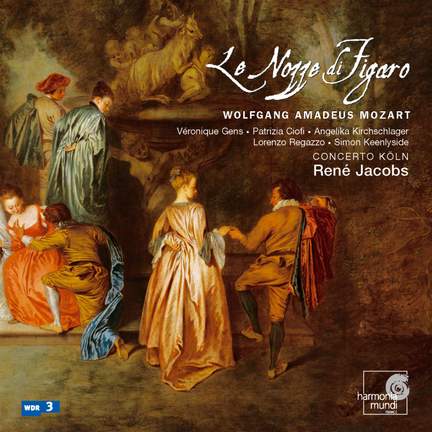
Mozart: Le nozze di Figaro, K492
Simon Keenlyside (Count), Véronique Gens (Countess), Patrizia Ciofi (Susanna), Lorenzo Regazzo (Figaro), Angelika Kirchschlager (Cherubino), Marie McLaughlin (Marcellina)
Collegium Vocale Gent, Concerto Köln, René Jacobs
Awards:
-
Gramophone Magazine, May 2004, Editor's Choice

-
Gramophone Awards, 2004, Recording of the Year

-
Gramophone Awards, 2004, Winner - Opera
-
Grammy Awards, 47th Awards (2004), Best Opera Recording

-
Building A Library, April 2022, Recommended Recording

René Jacobs always brings new ideas to the operas he conducts, and even to a work as familiar as Figaro he adds something of his own. First of all he offers an orchestral balance quite unlike...
Mozart: Le nozze di Figaro, K492
Simon Keenlyside (Count), Véronique Gens (Countess), Patrizia Ciofi (Susanna), Lorenzo Regazzo (Figaro), Angelika Kirchschlager (Cherubino), Marie McLaughlin (Marcellina)
Collegium Vocale Gent, Concerto Köln, René Jacobs
Purchase product

Awards:
-
Gramophone Magazine, May 2004, Editor's Choice
-
Gramophone Awards, 2004, Recording of the Year
-
Gramophone Awards, 2004, Winner - Opera
-
Grammy Awards, 47th Awards (2004), Best Opera Recording
-
Building A Library, April 2022, Recommended Recording
René Jacobs always brings new ideas to the operas he conducts, and even to a work as familiar as Figaro he adds something of his own. First of all he offers an orchestral balance quite unlike...
About
Winner of numerous awards including the Gramophone Record of the Year 2004, this is one of the must-have opera recordings of all time.
"This is the only suitable adjective to define what we are looking for, with our period instruments, our fast tempos, the performance of the recitatives, the ornaments added here and there by the singers, and a few other features that may surprise the audience: an approach that is not ‘Baroque’ – the term would be wholly out of place here – but ‘neo-Classical’, as opposed to the ‘post-Romantic’ one which began to determine our listening habits in the first half of the twentieth century. Every period has its own Mozart tradition; the neo-Classical approach is the fruit of an increasingly intense desire, not to ‘reconstruct’ musical performance practices of Mozart’s time, but to utilise them with the imagination proper to the individual personality of each musician, as important elements that are nevertheless subordinate to an overall vision." René Jacobs
Contents and tracklist
- Antonio Abete, Marie McLaughlin, René Jacobs, Concerto Köln
- Angelika Kirchschlager, René Jacobs, Concerto Köln, Simon Keenlyside, Patrizia Ciofi, Kobie Van Rensburg
- René Jacobs, Concerto Köln, Collegium Vocale Gent, Simon Keenlyside, Lorenzo Regazzo, Patrizia Ciofi, Angelika Kirchschlager, Kobie Van Rensburg
- Véronique Gens, Simon Keenlyside, René Jacobs, Angelika Kirchschlager, Concerto Köln, Patrizia Ciofi, Antonio Abete
- Simon Keenlyside, Marie McLaughlin, Véronique Gens, René Jacobs, Kobie Van Rensburg, Angelika Kirchschlager, Antonio Abete, Patrizia Ciofi, Concerto Köln
Awards and reviews
-
Gramophone MagazineMay 2004Editor's Choice
 2010
René Jacobs always brings new ideas to the operas he conducts, and even to a work as familiar as Figaro he adds something of his own. First of all he offers an orchestral balance quite unlike what we are used to. Those who specially relish a Karajan or a Solti will hardly recognise the work, with its strongly wind-biased orchestral balance: you simply don't hear the violins as the 'main line' of the music. An excellent corrective to a tradition that was untrue to Mozart, to be sure, but possibly the pendulum has swung a little too far.
Jacobs is freer over tempo than most conductors.
The Count's authoritarian pronouncements are given further weight by a faster tempo: it gives them extra decisiveness, though the music then has to slow down. There are other examples of such flexibility, sometimes a shade disconcerting, but always with good dramatic point. The Count's Act 3 duet with Susanna is one example: the little hesitancies enhanced and pointed up, if perhaps with some loss in energy and momentum. Tempos are generally on the quick side of normal, notably in the earlier parts of the Act 2 finale; but Jacobs is willing to hold back, too, for example in the Susanna-Marcellina duet, in the fandango, and in the G major music at the dénouement where the Count begs forgiveness.
The cast is excellent. Véronique Gens offers a beautifully natural, shapely 'Porgi amor' and a passionate and spirited 'Dove sono'. The laughter in Patrizia Ciofi's voice is delightful when she's dressing up Cherubino, and she has space in 'Deh vieni' for a touchingly expressive performance.
Then there's Angelika Kirschlager's Cherubino, alive and urgent in 'Non so più', every little phrase neatly moulded. Lorenzo Regazzo offers a strong Figaro, with a wide range of voice – angry and determined in 'Se vuol ballare', nicely rhythmic with some softer colours in 'Non più andrai', and pain and bitterness in 'Aprite'. The Count of Simon Keenlyside is powerful, menacing, lean and dark in tone. Marie McLaughlin sings Marcellina with unusual distinction.
Strongly cast, imaginatively directed: it's a Figaro well worth hearing.
 2010
René Jacobs conducts one of the refreshing versions of Figaro to be issued in many years...Véronique Gens is one of the most distinguished of Countesses, and Patrizia Ciofi is a sparkling Susanna, while Simon Keenlyside is a superb Count, well contrasted with the strongly acted Figaro of Lorenzo Regazzo.
 2nd April 2004
This is as fine a Figaro as has appeared on disc in the past 20 years...Most important of all, this is a version of Figaro that sounds as if it has come straight out of the theatre...It is hard to think of another recording of Figaro in which every particle of the text, in ensembles as well as solo numbers, is so clearly enunciated. That clarity aids everyone's characterisation.
