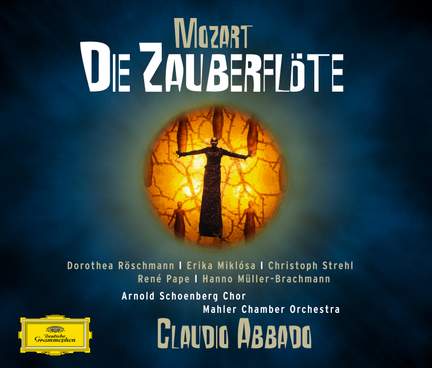
Mozart: Die Zauberflöte, K620
René Pape (Sarastro), Erika Miklósa (Königin der Nacht), Dorothea Röschmann (Pamina), Christoph Strehl (Tamino), Hanno Müller-Brachmann (Papageno), Julia Kleiter (Papagena), Georg Zeppenfeld (Sprecher), Kurt Azesberger (Monostatos), Caroline Stein (Erste Dame), Heidi Zehnder (Zweite Dame), Anne-Carolyn...
Awards:
-
Gramophone Awards, 2006, Finalist

-
BBC Music Magazine, June 2006, Disc of the month

-
Record Review, December 2006, Critics Disc of the Year

-
Gramophone Magazine, June 2006, Editor's Choice

-
Penguin Guide, Rosette

This is certainly the most desirable version using modern instruments to appear since Solti's second recording in 1990. That said, its characteristics are rather nearer William Christie's 1995...
Mozart: Die Zauberflöte, K620
René Pape (Sarastro), Erika Miklósa (Königin der Nacht), Dorothea Röschmann (Pamina), Christoph Strehl (Tamino), Hanno Müller-Brachmann (Papageno), Julia Kleiter (Papagena), Georg Zeppenfeld (Sprecher), Kurt Azesberger (Monostatos), Caroline Stein (Erste Dame), Heidi Zehnder (Zweite Dame), Anne-Carolyn...
Purchase product

We pay more royalties to artists and composers than any other streaming service with our innovative Fair Play pay-per-second model
We pay artists and composers fairly with our pay-per-second model
Awards:
-
Gramophone Awards, 2006, Finalist
-
BBC Music Magazine, June 2006, Disc of the month
-
Record Review, December 2006, Critics Disc of the Year
-
Gramophone Magazine, June 2006, Editor's Choice
-
Penguin Guide, Rosette
This is certainly the most desirable version using modern instruments to appear since Solti's second recording in 1990. That said, its characteristics are rather nearer William Christie's 1995...
About
Contents and tracklist
- Christoph Strehl (tenor), Anne-Caroline Schlüter (contralto), Heidi Zehnder (mezzo-soprano), Caroline Stein (soprano), Christoph Strehl (speaker), Hanno Müller-Brachmann (bass-baritone), Hanno Müller-Brachmann (speaker), Caroline Stein (speaker), Julia Kleiter (speaker), Anne-Caroline Schlüter (speaker), Heidi Zehnder (speaker), Erika Miklósa (soprano), Matthias Bernhold (speaker), Kurt Azesberger (speaker), Tobias Beyer (speaker), Martin Olbertz (speaker), Kurt Azesberger (tenor), Dorothea Röschmann (soprano), Dorothea Röschmann (speaker), Soloists of the Tölzer Knabenchor (boy soprano), Georg Zeppenfeld (speaker), Andreas Bauer (bass), Danilo Formaggia (tenor), René Pape (bass), René Pape (speaker), Danilo Formaggia (speaker), Erika Miklósa (speaker), Erwin Ortner (chorus master), Andreas Bauer (speaker), Sascha Borris (bass), Anne-Caroline Schlüter (countertenor)
- Mahler Chamber Orchestra, Arnold Schoenberg Chor
- Claudio Abbado
- Recorded: 2005-09-12
- Recording Venue: Teatro Comunale, Modena
Awards and reviews
-
BBC Music MagazineJune 2006Disc of the month
-
Record ReviewDecember 2006Critics Disc of the Year
-
Gramophone MagazineJune 2006Editor's Choice
-
Penguin GuideRosette
 2010
2010
This is certainly the most desirable version using modern instruments to appear since Solti's second recording in 1990. That said, its characteristics are rather nearer William Christie's 1995 period-performance (reviewed above).
Abbado undertook the opera for the first time in performances in Italy in 2005, directed by his son (the production was seen at the 2006 Edinburgh Festival). On this occasion, he conducts a direct, keenly articulated, inspiriting account of the score, obviously aware of what has been achieved in recent times by the authenticists, yet when he reaches the work at its most Masonic – the Act 2 trio and the scene with the Armed Men, Tamino and Pamina – Abbado, directing his beloved Mahler Chamber Orchestra, gives the music its true and wondrous import. The playing throughout is alert and scrupulously articulated.
Casts varied between performances; here Abbado assembled one predominantly chosen from a youngish generation of German-speaking singers, each of whom approaches his or her role with fresh sound and interprets it in impeccably Mozartian style. The Tamino and Pamina are well nigh faultless. Tamino has been taken by many outstanding tenors on disc but Christoph Strehl sings with a Wunderlich-like strength and beauty, and rather more light and shade than his famous predecessor brought to the role. His is a wonderfully virile, vital reading that gives pleasure to the ear, as much in ensemble as in aria. He is partnered by Dorothea Röschmann, who has already appeared as Pamina at Covent Garden, and in many other houses. Her full-throated, positive singing, finely shaped, cleanly articulated, is a true match for Strehl's.
Hanno Müller-Brachmann is a properly lively and amusing Papageno, and delivers the role in a richer bass-baritone than many interpreters provide. He doesn't attempt a Viennese accent in the dialogue (a fairly full version), but brings plenty of simple humour to the part. The high and low roles are well catered for. The Hungarian coloratura Erika Miklósa has been making a speciality of Queen of Night over the past few years and shows just why in a technically secure and fiery account of her two arias. René Pape sings Sarastro: now at the peak of his career, he conveys all the role's gravity and dignity in a gloriously sung performance. Kurt Azesberger is a suitably nasty Monostatos.
Abbado allows a few neatly executed decorations.
The extensive dialogue, spoken in a manner suitable for the theatre, sometimes sounds over-emphatic in the home, with the Papagena as an old woman the worst culprit. The recording is reasonably well balanced. As a whole the performance conveys a welcome immediacy and spontaneity and the daring of Abbado's way with the score is very alluring.
 June 2006
Abbado… conducts a direct, keenly articulated, inspiriting account of the score… The playing throughout is alert and scrupulously articulated. The Tamino and Pamina are well nigh faultless. …Christoph Strehl… sings with a Wunderlich-like strength and beauty... He is partnered by Dorothea Röschmann... Her full-throated, positive singing, finely shaped, cleanly articulated, is a true match for Strehl's. Hanno Müller-Brachmann is a properly lively and amusing Papageno... René Pape sings Sarastro: now at the peak of his career, he conveys all the role's gravity and dignity in a gloriously sung performance.
 2010
2010
...a triumphant success. René Pape's magnificent Sarastro dominates the opera, just as intended...But most magical of all are the little vocal ensembles, wonderfully warm and refined...this is above all an affectionately relaxed performance, with Abbado continually revelling in the lyrical beauty of Mozart's wonderful score.