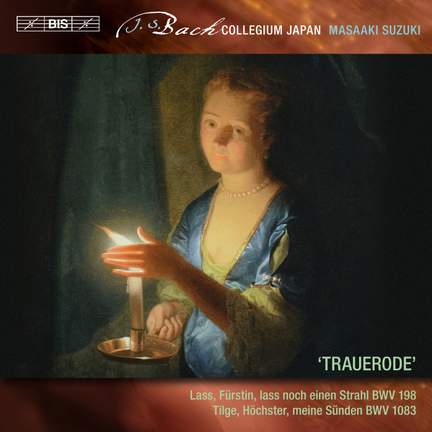
Bach - Secular Cantatas VI
Carolyn Sampson (soprano), Joanne Lunn (soprano), Robin Blaze (counter-tenor), Gerd Türk (tenor) & Dominik Wörner (bass)
Bach Collegium Japan, Masaaki Suzuki
Awards:
-
Building a Library, June 2016, Also Recommended

Bach Collegium Japan produce a delectable vision in quasi-Passion clothes…the choruses captivatingly detailed, luminous and with just enough galant accentuation…Suzuki delivers a captivating...
Bach - Secular Cantatas VI
Carolyn Sampson (soprano), Joanne Lunn (soprano), Robin Blaze (counter-tenor), Gerd Türk (tenor) & Dominik Wörner (bass)
Bach Collegium Japan, Masaaki Suzuki
Purchase product

Awards:
-
Building a Library, June 2016, Also Recommended
Bach Collegium Japan produce a delectable vision in quasi-Passion clothes…the choruses captivatingly detailed, luminous and with just enough galant accentuation…Suzuki delivers a captivating...
About
Although Bach's sacred cantatas span a huge expressive range and display a striking stylistic diversity, they were all composed for church service. In the case of the secular cantatas, on the other hand, their respective purpose is as varied as their subject matter and emotional content. They were usually commissions intended for occasions such as weddings, funerals and birthdays. As such they were sometimes performed in churches, and some of them have religious texts, but as the works gathered here show, they were not related to the particular theme of the church service on a certain day. The cantata BWV 198, often called the Trauerode (funeral ode) was performed at an imposing ceremony in Leipzig's Paulinerkirche in 1727, held in order to mark the passing of Christiane Eberhardine, wife of Augustus the Strong, Elector of Saxony and King of Poland. Compared to BWV 198, the circumstances surrounding Tilge, Höchster, meine Sünden, BWV 1083, are far more uncertain: why Bach at a late stage in his life (around 1746) decided to make an arrangement of Pergolesi's famous Stabat mater isn't known. In the case of the Pergolesi arrangement, the text is religious – a German paraphrase of the penitential Psalm 51 replaces the medieval sequence about Mary mourning Christ at the cross – but the work doesn't seem to have had any liturgical purpose.
Contents and tracklist
- Joanne Lunn, Robin Blaze, Gerd Türk
- Bach Collegium Japan, Bach Collegium Japan Chorus
- Masaaki Suzuki
- Recorded: February 2015
- Recording Venue: Kobe Shoin Women's University Chapel, Japan
- Gerd Türk, Dominik Wörner
- Bach Collegium Japan, Bach Collegium Japan Chorus
- Masaaki Suzuki
- Recorded: February 2015
- Recording Venue: Kobe Shoin Women's University Chapel, Japan
- Robin Blaze
- Bach Collegium Japan
- Masaaki Suzuki
- Recorded: February 2015
- Recording Venue: Kobe Shoin Women's University Chapel, Japan
- Carolyn Sampson, Robin Blaze, Joanne Lunn
- Bach Collegium Japan
- Masaaki Suzuki
- Recorded: September 2005
- Recording Venue: Kobe Shoin Women's University Chapel, Japan
Awards and reviews
 May 2016
Bach Collegium Japan produce a delectable vision in quasi-Passion clothes…the choruses captivatingly detailed, luminous and with just enough galant accentuation…Suzuki delivers a captivating narrative of sadness leading seamlessly and reassuringly to idealism