US TARIFFS UPDATE | August 2025 | No impact expected on your Presto orders | Read full details
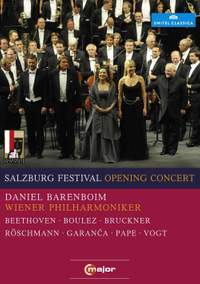
Salzburg Opening Concert 2010
Daniel Barenboim (piano), Dorothea Roschmann (soprano), Elīna Garanča (mezzo), Klaus Florian Vogt (tenor), René Pape (bass)
Vienna Philharmonic Orchestra, Chorus State Opera Vienna
there is no doubting the powerful authority that characterizes Barenboim's direction of Beethoven's Fourth Piano Concerto from the keyboard. Perhaps rather unexpectedly, the magic really starts...
Salzburg Opening Concert 2010
Daniel Barenboim (piano), Dorothea Roschmann (soprano), Elīna Garanča (mezzo), Klaus Florian Vogt (tenor), René Pape (bass)
Vienna Philharmonic Orchestra, Chorus State Opera Vienna
Purchase product
there is no doubting the powerful authority that characterizes Barenboim's direction of Beethoven's Fourth Piano Concerto from the keyboard. Perhaps rather unexpectedly, the magic really starts...
About
The opening concert of the Salzburg Festival, for many regarded as the world’s most renowned music festival, is by tradition a high-profile event.
In 2010 the Festival celebrated its 90th anniversary and the 50th anniversary of the Great Festival Hall.
Barenboim, in 2010 also celebrated his 60th anniversary onstage, excelled as a soloist and conductor of Beethoven’s lyrical Fourth Piano Concerto. Bruckner´s poignant Te Deum is performed by a quartet of world-class singers.
Running Time Total: 90 minutes
BD: dts-HD MA 5.1, PCM Stereo
Bruckner Te Deum: G, E, F, Sp, Korean, Chinese
Contents and tracklist
- Daniel Barenboim (piano)
- Wiener Philharmoniker
- Daniel Barenboim

- Dorothea Roschmann (soprano), Elīna Garanča (mezzo), Klaus Florian Vogt (tenor), René Pape (bass)
- Chorus State Opera Vienna, Wiener Philharmoniker
- Daniel Barenboim
Awards and reviews
January 2012
there is no doubting the powerful authority that characterizes Barenboim's direction of Beethoven's Fourth Piano Concerto from the keyboard. Perhaps rather unexpectedly, the magic really starts with a reading of Boulez's Notations I-IV and VII (finishing with II), whose intoxicating allure and expressivity is strongly reminiscent of the kind of sound Karajan generated in his classic Second Viennese School recordings of the 1970s.