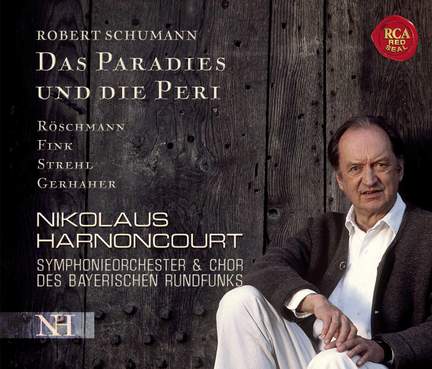
Schumann: Das Paradies und die Peri, Op. 50
Dorothea Röschmann, Bernarda Fink, Werner Güra & Christian Gerhaher
Symphonie-Orchester des Bayerischen Rundfunks, Chor des Bayerischen Rundfunks, Nikolaus Harnoncourt
Awards:
-
Gramophone Magazine, October 2008, Editor's Choice

Initially envisaged as an opera, Schumann's haunting 1843 oratorio Das Paradies und die Peri tells of how a Peri – according to Persian mythology, the 'impure' child of a fallen angel and a...
Schumann: Das Paradies und die Peri, Op. 50
Dorothea Röschmann, Bernarda Fink, Werner Güra & Christian Gerhaher
Symphonie-Orchester des Bayerischen Rundfunks, Chor des Bayerischen Rundfunks, Nikolaus Harnoncourt
Purchase product

We pay more royalties to artists and composers than any other streaming service with our innovative Fair Play pay-per-second model
We pay artists and composers fairly with our pay-per-second model
Awards:
-
Gramophone Magazine, October 2008, Editor's Choice
Initially envisaged as an opera, Schumann's haunting 1843 oratorio Das Paradies und die Peri tells of how a Peri – according to Persian mythology, the 'impure' child of a fallen angel and a...
About
Das Paradies und die Peri tells the story of the Peri, a creature from Persian and Islamic mythology. She has been expelled from Paradise and tries to regain entrance by giving the gift that is most dear to heaven. Eventually, the Peri is admitted after bringing a tear from the cheek of a repentant old sinner who has been moved by a child praying.
Live recordingContents and tracklist
Teil 1: Und einsam steht ein Jüngling (Solo-Tenor, Gazna, Bass und Jüngling, Tenor; Chor)
Track length2:52
Teil 2: Ihr erstes Himmelshoffen schwand (Solo-Tenor); Hervor aus den Wässern (Chor der Genien des Nils)
Track length3:49
Teil 2: Die Peri weint (Solo-Tenor); Denn in der Thrän' ist Zaubermacht (Quartett-Solo)
Track length2:42
Teil 3: Hinab zu jenem Sonnentempel (Solo-Peri, Tenor, Mezzo-Sopran und der Mann, Bariton)
Track length6:53
Awards and reviews
-
Gramophone MagazineOctober 2008Editor's Choice
 2010
2010
Initially envisaged as an opera, Schumann's haunting 1843 oratorio Das Paradies und die Peri tells of how a Peri – according to Persian mythology, the 'impure' child of a fallen angel and a human female – can enter Paradise only if she arrives at Heaven's gates with a worthy offering. Her first two offerings (a hero's blood and a vision of selfless love) fail the test whereas a third (abstinence inspired by a child at prayer) wins her Heavenly access.
Clara Schumann thought Das Paradies her husband's finest work and Nikolaus Harnoncourt calls it a 'splendid' score. So why the neglect? Partly negative political memory, maybe (Goebbels commissioned an arrangement that emphasised sacrificial death), and partly the work's hybrid nature. But it contains music that is at once dramatic, lyrical, ethereal, deeply personal and shot through with sincere human feeling. Mendelssohn's influence is discernible more or less throughout, especially in the choral writing which is very lightly dispatched on this superb 2005 performance from Munich's 'shoebox' Herkulessaal. The dramatic core is vividly exemplified by the chorus 'Doch seine Ströme sind jetzt rot', which reports rivers of human blood, whereas the transition to the tenor solo about the felled hero is meltingly beautiful, Christoph Strehl on excellent form.
Bach is another obvious point of reference, particularly at the point where the mezzo (Bernarda Fink) sings of a plague-inflected youth facing death, 'Verlassner Jüngling', music that's unmistakably reminiscent of Bach's Passion music and where Harnoncourt leans meaningfully on every fourth note of the strings' accompaniment.
His Bavarian RSO sound warm, though period awareness on the conductor's part ensures sonorities that are light and pointedly attenuated.
 October 2008
Das Paradies… contains music that is at once dramatic, lyrical, ethereal, deeply personal and shot through with sincere human feeling. I prefer Gardiner's principal tenor Christoph Prégardien to Harnoncourt's heavier-voiced Strehl but the consistently intense and expressive Dorothea Röschmann wins out over the creamy but less dramatically engaging Barbara Bonney. Harnoncourt's Bavarian RSO sound warm, though period awareness on the conductor's part ensures sonorities that are light and pointedly attenuated.
 25th May 2008
With Dorothea Roschmann in the title role, and luxury support from the likes of Bernarda Fink and Christian Gerhaher, Harnoncourt lends this charming work the polish it deserves.
 28th June 2008
Nikolaus Harnoncourt rivals John Eliot Gardiner (Archiv) in his acute feeling for pacing and atmosphere, and his sympathetic handling of Schumann's potentially square rhythmic structures.
Chorus, orchestra and soloists could hardly be bettered, with Christoph Strehl a lyrically eloquent narrator and Dorothea Röschmann by turns tender and fierily intense as the questing heroine.
 24th May 2008
Bar a few ponderous moments in the otherwise fine cast, Harnoncourt, with the Bavarian Radio Symphony, is a gripping judge of narrative, exploiting the loneliness of Peri's disconsolate sobbing outside the gates of Heaven. Dorothea Röschmann is excellent as Peri, fluidly colouring hope and despair.