Verdi: La forza del destino
Ludwig Welter (Marchese di Calatrava), Antonietta Stella (Leonora), Ettore Bastianini (Don Carlo), Giuseppe di Stefano (Alvaro), Giulietta Simionato (Preziosilla), Walter Kreppel (Padre Guardiano), Karl Dönch (Fra Melitone), Annemarie Ludwig (Curra)
Choir & Orchestra of the Vienna State...
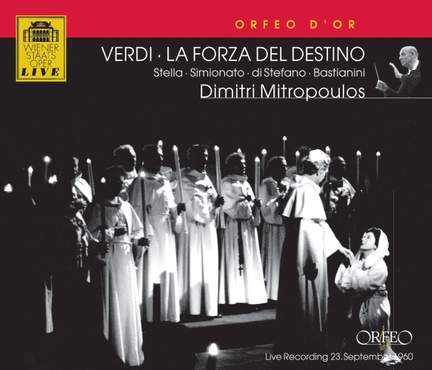
Mitropoulos, who had only weeks to live, directs the work with that combination of sensitivity and drive that marked all his performances.
With the Vienna State Opera Orchestra in glowing form,...
Verdi: La forza del destino
Ludwig Welter (Marchese di Calatrava), Antonietta Stella (Leonora), Ettore Bastianini (Don Carlo), Giuseppe di Stefano (Alvaro), Giulietta Simionato (Preziosilla), Walter Kreppel (Padre Guardiano), Karl Dönch (Fra Melitone), Annemarie Ludwig (Curra)
Choir & Orchestra of the Vienna State...
Purchase product

We pay more royalties to artists and composers than any other streaming service with our innovative Fair Play pay-per-second model
We pay artists and composers fairly with our pay-per-second model
Mitropoulos, who had only weeks to live, directs the work with that combination of sensitivity and drive that marked all his performances.
With the Vienna State Opera Orchestra in glowing form,...
About
Contents and tracklist
- Ludwig Welter, Antonietta Stella, Anne-Marie Ludwig, Giuseppe di Stefano, Ettore Bastianini, Giulietta Simionato, Harald Pröglhöf, Hugo Meyer-Welfing, Walter Kreppel, Karl Dönch, Franz Bierbach
- Wiener Staatsoper, Chor der Wiener Staatsoper
- Dimitri Mitropoulos
- Recorded: 23 September 1960
- Recording Venue: Live recording, Osterreichischen Rundfunks, Austria
Act II: Hola, hola, hola! Ben giungi, o mulattier (Chorus, Alcalde, Carlo, Leonora, Trabuco, Preziosilla)
Track length3:20
Act II: Il santo nome di Dio Signore - La Vergine degli angeli (Guardiano, Melitone, Chorus, Leonora)
Track length11:25
Act IV: Auf! … Pazienza non v'ha che basti! - Del mondo i disinganni (Melitone, Guardiano)
Track length4:27
Awards and reviews
 2010
2010
Mitropoulos, who had only weeks to live, directs the work with that combination of sensitivity and drive that marked all his performances.
With the Vienna State Opera Orchestra in glowing form, the results are very special. One quirk: rather than playing the Overture at the beginning, Mitropoulos places it after the first scene, a plan Verdi had but eventually abandoned.
It works quite well, at least when played with the élan evident here.
Bastianini presents Don Carlo in all his menacing, vengeful fury with that dark-hued, immensely powerful baritone of his. As his antagonist he has Di Stefano as Alvaro in his most eloquent, incisive and appealing form, relishing every word and note. If it's possible, the Leonora and Preziosilla are even better. Stella had a brief period when she was fully the equal of Tebaldi and here she is in the middle of it, singing the role as well as, if not better than any soprano on disc. Tebaldi-like in her full, Italianate tone, Caniglia-like in her identification with Leonora's plight, from start to finish she is magnificent, and she crowns her portrayal with a finely nuanced and felt 'Pace, pace' in the final act. Simionato was always one of the few mezzos who had the range and brio to fulfil the demands of Preziosilla's part, and she too is here at her appreciable best.
The rest of the cast is drawn from resident singers at the Staatsoper. Kreppel is a sound, fullbottomed bass who sings a sympathetic Padre Guardiano, especially fine in the long Act 2 duet with Leonora. But the rest are not half as idiomatic as their Italian counterparts in Florence, with Dönch comic as Melitone but in rather a Viennese way. Another drawback is the traditional cuts then imposed on the score; particularly heinous is the excising of Alvaro/Carlo duet in Act 3.
In this the performance's first official appearance, the sound is by and large excellent.
Although there is no libretto, there are interesting notes in the booklet by Gottfried Kraus and Michael Gielen (on Mitropoulos).