Rossini: Guglielmo Tell
Sherrill Milnes, Luciano Pavarotti, Mirella Freni, Nicolai Ghiaurov, John Tomlinson, Della Jones, Elizabeth Connell, Richard Van Allan, Piero de Palma
National Philharmonic Orchestra, Riccardo Chailly
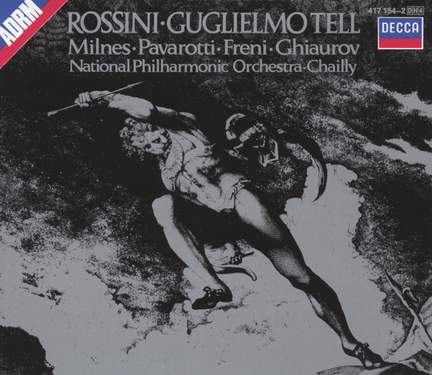
If ever there was a case for armchair opera it's Rossini's Guglielmo Tell. The very limitations which have made it, so far, a non-repertory work, give space for the imagination to redress the...
Rossini: Guglielmo Tell
Sherrill Milnes, Luciano Pavarotti, Mirella Freni, Nicolai Ghiaurov, John Tomlinson, Della Jones, Elizabeth Connell, Richard Van Allan, Piero de Palma
National Philharmonic Orchestra, Riccardo Chailly
Purchase product

We pay more royalties to artists and composers than any other streaming service with our innovative Fair Play pay-per-second model
We pay artists and composers fairly with our pay-per-second model
If ever there was a case for armchair opera it's Rossini's Guglielmo Tell. The very limitations which have made it, so far, a non-repertory work, give space for the imagination to redress the...
About
Contents and tracklist
- Cesar Antonio Suarez (tenor), Elizabeth Connell (mezzo-soprano), Della Jones (mezzo-soprano), Sherrill Milnes (baritone), John Tomlinson (bass), Luciano Pavarotti (tenor), Richard van Allan (bass), Piero de Palma (tenor), Mirella Freni (soprano), Nicolai Ghiaurov (bass), Ferruccio Mazzoli (bass)
- National Philharmonic Orchestra, Ambrosian Singers
- Riccardo Chailly
- Recorded: 1979-06-08
- Recording Venue: Kingsway Hall, London
Awards and reviews
 2010
2010
If ever there was a case for armchair opera it's Rossini's Guglielmo Tell. The very limitations which have made it, so far, a non-repertory work, give space for the imagination to redress the balance: the short, Rousseau-esque scenes of life by Lake Lucerne, the distant entrances and exits of shepherds and huntsmen, the leisurely but perfectly balanced side-vignettes of fisherman, hunter, child.
Thanks to the clarity and liveliness of the recording itself and, above all, the shrewd casting, this set creates a vivid charivari of fathers, sons, lovers and patriots, all played out against some of Rossini's most delicately painted pastoral cameos. Chailly keeps up the undercurrent of tension between private love and public loyalty, as well as working hard the rustic jollity of the score. Tell himself could hardly have a better advocate than Sherrill Milnes. Arnoldo and Matilde, too, are cleverly cast. Pavarotti contains the coarse, direct impulsiveness of Arnoldo's shepherd stock with the tenderness of love, in his characteristic charcoal cantabile and the numbness of his remorse.
Mirella Freni, singing opposite Pavarotti as the forbidden Princess Matilde, phrases with aristocratic poise, folding into every fragment of embryonic bel canto the fragile ardour of a young girl's love. The vocal chemistry between them in their Act 2 declaration of love is a lively incarnation of their roles. A similarly interesting patterning of vocal timbres is produced by the casting of Elizabeth Connell as Edwige, Tell's wife, and of Della Jones as Jemmy, their son. Their last-act Trio with Matilde is matched by the contrasting colours of the basses of Ghiaurov, Tomlinson and Van Allan: their roles may be small, but their characters are vividly stamped on an excellent ensemble performance.