

Help
Skip to main content

US TARIFFS UPDATE | August 2025 | No impact expected on your Presto orders | Read full details

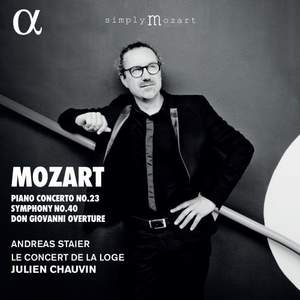
Mozart: Piano Concerto No. 23, Symphony No. 40 & Don Giovanni Overture

Andreas Staier, Le Concert de La Loge, Julien Chauvin

Mozart: Piano Concerto No. 23, Symphony No. 40 & Don Giovanni Overture

Awards:

Staier’s approach is of the interventionist type, playing in introductions and tuttis and ornamenting freely.

Mozart: Piano Concerto No. 23, Symphony No. 40 & Don Giovanni Overture

Andreas Staier, Le Concert de La Loge, Julien Chauvin

Purchase product

CD

$18.25

Usually despatched in 3 - 4 working days

Download

From$9.25

Download

Audio formats guide

96 kHz, 24 bit, FLAC/ALAC/WAV

$18.25

44.1 kHz, 16 bit, FLAC/ALAC/WAV

$13.75

320 kbps, MP3

$9.25

This release includes a digital booklet

Stream now Hi-RES 96 kHz, 24 bit

Awards:

Staier’s approach is of the interventionist type, playing in introductions and tuttis and ornamenting freely.

About

Julien Chauvin meets up with one of the great harpsichordists and fortepianists of our time, Andreas Staier, who is a leading interpreter of the Mozart concertos. He presents us with his vision of the Piano Concerto no.23 and its famous Adagio, ‘one of the most heart-rending slow movements ever written by Mozart . . . Performers often tend to take it too slowly, certainly thinking that this will accentuate the tragic side, but Julien Chauvin and I spontaneously agreed on a slightly faster tempo, which respects the basic pulse of this movement in siciliana rhythm. When you start with the right tempo, it’s amazing how the whole discourse comes together perfectly, in a very logical and simple manner’, says Staier, who plays a magnificent instrument by Christoph Kern after a 1790 fortepiano by Anton Walter, the great maker of Mozart’s time. Also on the programme is the Symphony no.40, in which, says Julien Chauvin, ‘Mozart explores types of writing that he pushes to their most extreme limits. This is the case in the finale, where we find a succession of dissonant disjunct intervals at the opening of the development which, on closer inspection, present us with the full chromatic scale (except for G natural, the symphony’s tonic). And so the twelve-note series was born!’

Contents and tracklist

I. Allegro
Track length11:02
II. Adagio
Track length6:33
III. Allegro assai
Track length7:55
I. Molto allegro
Track length6:51
II. Andante
Track length9:11
III. Menuetto
Track length3:21
IV. Allegro assai
Track length6:24

Awards and reviews

  • International Classical Music Awards
    2023
    Nominated - Assorted Programs

November 2022

Staier’s approach is of the interventionist type, playing in introductions and tuttis and ornamenting freely.
View download progress