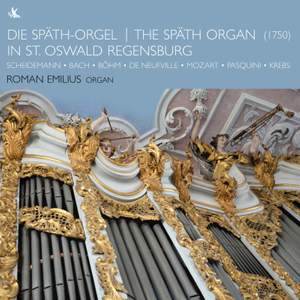


Offer,The Spath Organ in St Oswald Regensburg
Roman Emilius (organ)
CD
Original price ($17.50) Reduced price $14.50Downloads
What are FLAC and MP3?Contents
Scheidemann: Toccata in G major, WV 43
Work length8:07
$2.00
$2.60
- Roman Emilius (organ)
Bach, J S: Chorale Prelude BWV659 'Nun komm, der Heiden Heiland'
Work length6:01
$1.00
$1.30
- Roman Emilius (organ)
Böhm, G: Partita 'Freu dich sehr, o meine Seele'
Work length17:09
$4.00
$5.15
- Roman Emilius (organ)
Neufville: Ciaccona in B minor
Work length6:05
$1.00
$1.30
- Roman Emilius (organ)
Bach, J S: Fantasia & Fugue in A minor, BWV561
Work length8:57
$2.00
$2.60
- Roman Emilius (organ)
Mozart: Adagio in C major, K356
Work length4:33
$1.00
$1.30
- Roman Emilius (organ)
Pasquini, B: Toccata con lo Scherzo del Cucco
Work length5:06
$1.00
$1.30
- Roman Emilius (organ)
Krebs, J L: Fantasia in F major, Krebs-WV 419
Work length1:28
$1.00
$1.30
- Roman Emilius (organ)
Krebs, J L: Fantasia à gusto italiano
Work length4:04
$1.00
$1.30
- Roman Emilius (organ)
Krebs, J L: Fantasia and Fugue in F major Krebs-WV 420
Work length2:12
$1.00
$1.30
- Roman Emilius (organ)
I. Fantasia
Track length2:12
$1.00
$1.30