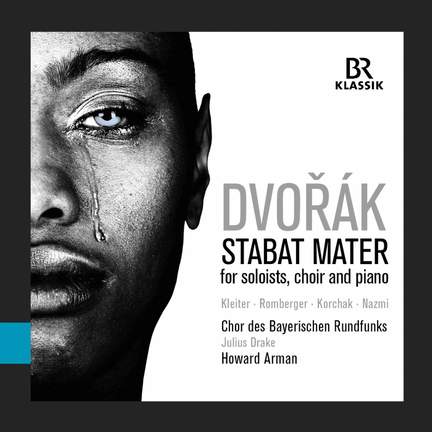
Dvořák: Stabat Mater
version for soloists, choir and piano
Julia Kleiter (soprano), Gerhild Romberger (mezzo), Dmitry Korchak (tenor), Tareq Nazmi (bass), Julius Drake (piano)
Chor des Bayerischen Rundfunks, Howard Arman
Awards:
-
International Classical Music Awards, 2019, Nominee - Choral

-
Opus Klassik Awards, 2020, Nominee - Female Singer of the Year (Romberger)

-
Opus Klassik Awards, 2020, Nominee - Male Singer of the Year (Nazmi)
-
Opus Klassik Awards, 2020, Nominee - Conductor of the Year
The excellent Bavarian Radio Chorus are encouraged to phrase accordingly, and the advantages of a compact, professional chorus in a work usually belonging to the choral-society tradition make...
Dvořák: Stabat Mater
version for soloists, choir and piano
Julia Kleiter (soprano), Gerhild Romberger (mezzo), Dmitry Korchak (tenor), Tareq Nazmi (bass), Julius Drake (piano)
Chor des Bayerischen Rundfunks, Howard Arman
Purchase product

Awards:
-
International Classical Music Awards, 2019, Nominee - Choral
-
Opus Klassik Awards, 2020, Nominee - Female Singer of the Year (Romberger)
-
Opus Klassik Awards, 2020, Nominee - Male Singer of the Year (Nazmi)
-
Opus Klassik Awards, 2020, Nominee - Conductor of the Year
The excellent Bavarian Radio Chorus are encouraged to phrase accordingly, and the advantages of a compact, professional chorus in a work usually belonging to the choral-society tradition make...
About
The “Stabat mater” by the Bohemian composer Antonin Dvořák, well-known in its later orchestralversion, was initially composed with piano accompaniment. This rarely-heard original version has now been recorded for this new CD from BR-KLASSIK, featuring the excellent Bavarian Radio Chorus under the direction of Howard Arman, and accompanied by Julius Drake on the piano. The young Dvořák was a well-studied and experienced church musician. Having graduated from the organ school in Prague, he spent three pious years as an organist in the city’s St. Adalbert’s Church. The search for a “truly sacred music” preoccupied him from the very start. The contemporary Caecilian Movement for church music reform led him, like many of his colleagues, to re-examine the Palestrina style, which represented a return to the more modest, less ostentatious and yet at the same time contrapuntally ingenious church music of a previous epoch. He duly composed a ”Stabat mater” without orchestral splendour and with a simple piano accompaniment. Shortly before Dvořák wrote down this first version of his ”Stabat mater” between February 19 and May 7, 1876, a heavy blow had struck the young family. On December 19, 1875, his daughter Josefa died two days after she was born. (It was only in August 1877 that the composer returned to the”Stabat Mater” again, orchestrated the work, and completed it on November 13. The premiere of that later version took place on December 23, 1880 in Prague). – Dvořák did not set all the verses of the hymn to music, and chose an ensemble of four soloists, a choir and a piano. This original version from the spring of 1876, with its seven-movement structure, is not a fragment, draft or piano reduction but an independent and self-contained work in its own right. In the autumn of 1877, when he composed the missing four verses and scored his ”Stabat mater” for a large orchestra, he effectively created a new and different work.
Contents and tracklist
Awards and reviews
-
International Classical Music Awards2019Nominee - Choral
-
Opus Klassik Awards2020Nominee - Female Singer of the Year (Romberger)
-
Opus Klassik Awards2020Nominee - Male Singer of the Year (Nazmi)
-
Opus Klassik Awards2020Nominee - Conductor of the Year
 January 2020
The excellent Bavarian Radio Chorus are encouraged to phrase accordingly, and the advantages of a compact, professional chorus in a work usually belonging to the choral-society tradition make themselves felt throughout…The soloists make a well-matched team slightly let down by an unduly Italianate tenor.
 February 2020
I particularly admire the way in which Julius Drake handles this, playing with great poise and delicacy....the Bavarian Radio choir under Howard Arman make a very convincing argument for its legitimacy as more than a sketch for the better-known 10-movement version with orchestra.