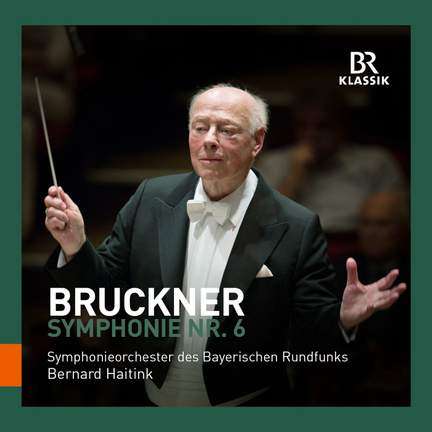
Bruckner: Symphony No. 6 in A major
Symphonieorchester des Bayerischen Rundfunks, Bernard Haitink
Awards:
-
BBC Music Magazine, March 2018, Orchestral Choice

This is very nearly my perfect Bruckner Six…The slow movement is relatively fast-paced, and when I first heard it I couldn’t help wishing that it would expand just a bit more. But Bernard Haitink’s...
Bruckner: Symphony No. 6 in A major
Symphonieorchester des Bayerischen Rundfunks, Bernard Haitink
Purchase product

Awards:
-
BBC Music Magazine, March 2018, Orchestral Choice
This is very nearly my perfect Bruckner Six…The slow movement is relatively fast-paced, and when I first heard it I couldn’t help wishing that it would expand just a bit more. But Bernard Haitink’s...
About
For a long time, Anton Bruckner’s Sixth Symphony (alongside the Second) was regarded as something of a ‘poor relation’ in his immense symphonic oeuvre, although the composer himself had moodily referred to it as his "boldest". Over the decades, in view of its performance figures and recordings, this changed significantly: The work has now secured itself a permanent place in the repertoire. The Sixth Symphony belongs to the creative process of the two preceding symphonies, the "Romantic" Fourth and the Fifth, and is now understood as an important preliminary stage in Bruckner’s last great upsurge that followed the composition of the "Te Deum" and culminated in the sublime grandeur of his final symphonies, the Seventh, Eighth, and Ninth. The "very solemn" Adagio of the Sixth Symphony, in particular, provided the model for the famous Adagio of the Seventh Symphony that followed it. Bruckner worked on his Sixth Symphony from September 1879 to September 1881. During his lifetime, he was only able to hear the complete work at one orchestra rehearsal, because only the two middle movements were publicly performed in the concert hall of the Vienna Musikverein on February 11, 1883. The first public performance of the symphony in its entirety followed only on February 26, 1899 - two and a half years after the composer’s death. It was conducted by Gustav Mahler, who, however, had made changes to the score and presented it in a radically shortened version. Bruckner's first-hand version was heard for the first time in Stuttgart on March 14, 1901, and it would take until October 9th, 1935, for the sixth symphony to be first performed as Bruckner's original score prescribed.The recent Munich concert performance of May 2017 has now been released on CD by BR-KLASSIK. This outstanding interpretation of one of the key compositions in the Late Romantic symphonic repertoire is conducted by Bernard Haitink.
Contents and tracklist
- Symphonie-Orchester des Bayerischen Rundfunks
- Bernard Haitink
- Recorded: 4-5 May 2017
- Recording Venue: Philharmonie im Gasteig, München
Awards and reviews
-
BBC Music MagazineMarch 2018Orchestral Choice
 March 2018
This is very nearly my perfect Bruckner Six…The slow movement is relatively fast-paced, and when I first heard it I couldn’t help wishing that it would expand just a bit more. But Bernard Haitink’s feeling for the way this music sings is so persuasive…that in the end I just surrendered and accepted it on its own terms…The music feels fresh, alert, expressive at all times, whether in moments of joy, mystery or the darkest desolation.
 February 2018
Haitink’s interpretation of the first movement in this new recording leans towards the doctrinaire…but the recording is more sympathetic than in the Dresden and the orchestral response is notably more refined. Dynamic markings are meticulously observed throughout, and the solo contributions are excellent…This is the recording to choose for anyone wanting to hear Haitink in this symphony.
Classical Ear January 2018
The scherzo strides forth determinedly and the trio is given intent, shape and pastoral benediction. The finale is similarly in search of a goal- and find it.