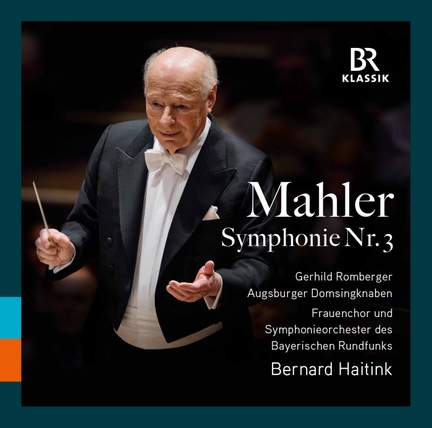
Mahler: Symphony No. 3
Gerhild Romberger (mezzo-soprano)
Augsburger Domsingknaben, Frauenchor des Bayerischen Rundfunks, Symphonieorchester des Bayerischen Rundfunks, Bernard Haitink
Awards:
-
Presto Recording of the Week, 6th January 2017

-
BBC Music Magazine, May 2017, Orchestral Choice

-
Presto Recordings of the Year, Finalist 2017

-
BBC Music Magazine Awards, 2018, Winner - Orchestral

-
BBC Music Magazine Awards, 2018, Recording of the Year
-
Record Review, 7th January 2017, Recording of the Week

a perfect beauty of a performance, natural sound matching natural evoution and every solo perfectly intoned
Mahler: Symphony No. 3
Gerhild Romberger (mezzo-soprano)
Augsburger Domsingknaben, Frauenchor des Bayerischen Rundfunks, Symphonieorchester des Bayerischen Rundfunks, Bernard Haitink
Purchase product

Awards:
-
Presto Recording of the Week, 6th January 2017
-
BBC Music Magazine, May 2017, Orchestral Choice
-
Presto Recordings of the Year, Finalist 2017
-
BBC Music Magazine Awards, 2018, Winner - Orchestral
-
BBC Music Magazine Awards, 2018, Recording of the Year
-
Record Review, 7th January 2017, Recording of the Week
a perfect beauty of a performance, natural sound matching natural evoution and every solo perfectly intoned
About
Gustav Mahler's Third Symphony still ranks today as one of the greatest and most powerful creations of the Late Romantic period. The huge symphony, longer and more monumental than the others and containing texts from the collection of poems by Clemens Brentano and Achim von Arnim entitled “Des Knaben Wunderhorn”, was composed over a period of four years from 1892 to 1896, and especially during the summers of 1895 and 1896, which Mahler spent at the Attersee in Austria. Following performances of several individual movements of the symphony, the complete work was premiered on June 9, 1902, at the 38th “Tonkünstler Festival” in Krefeld. Mahler conducted the Städtische Kapelle Krefeld and Cologne’s Gürzenich Orchestra at this exciting event. It was one of his greatest successes, and his contemporaries were deeply impressed. Between 1902 and 1907, the composer conducted his Third Symphony a further 15 times.
Of the six powerful movements, the slow fourth one requires not only a large orchestra but also a mezzo-soprano solo for a setting of the “Midnight Song” (“O Man! Take heed!”) from Friedrich Nietzsche's poetical-philosophical "Thus Spoke Zarathustra," while in the cheerful fifth movement the mezzo-soprano soloist is joined by a children’s choir and a female chorus for the song Es sungen drei Engel from "Des Knaben Wunderhorn". The symphony is a huge challenge for all its performers, and this concert recording of June 2016 has a prestigious line-up: guest conductor Bernard Haitink with the Symphonieorchester des Bayerischen Rundfunks, the Augsburger Domsingknaben and the Frauenchor des Bayerischen Rundfunks; the solo parts are sung by Gerhild Romberger.
Contents and tracklist
- Gerhild Romberger (mezzo-soprano)
- Augsburger Domsingknaben, Frauenchor des Bayerischen Rundfunks, Symphonie-Orchester des Bayerischen Rundfunks
- Bernard Haitink
- Recorded: 15-17 June 2016
- Recording Venue: Philharmonie im Gasteig, Munich, Germany
Spotlight on this release
-
Bernard Haitink conducts Mahler's Third Symphony
6th Jan 2017
Katherine listens to Bernard Haitink's new recording of Mahler's Symphony No. 3 with the Bavarian Radio Symphony Orchestra.

Awards and reviews
-
Presto Recording of the Week6th January 2017
-
BBC Music MagazineMay 2017Orchestral Choice
-
Presto Recordings of the YearFinalist 2017
-
Record Review7th January 2017Recording of the Week
 May 2017
a perfect beauty of a performance, natural sound matching natural evoution and every solo perfectly intoned
 August 2017
While the performance feels most engaged when the music is in repose, the inner movements are more than adequately eloquent. The excellent posthorn solos in the third are credited to Martin Angerer…Gerhild Romberger has an old-fashioned contralto-ish timbre in the Nietzsche setting…the choirs sound lovely in the fifth movement and the finale has always been a Haitink speciality, plainly spoke and all the more moving for it.
 May 2017
Haitink seems just a pure conduit for the music.
 6th January 2017
Haitink has long been regarded as one of our least egocentric and interventionist conductors, and I don’t think I’ve ever felt that more keenly than on this recording...throughout the long first movement in particular, there’s a sense that the music is simply being allowed to unfold itself organically rather than being driven too hard.
Classical Ear 17th April 2017
The opening horn unison arrests and promises much, Mahler’s Third delivered with the long view typical of Bernard Haitink. He doesn’t sensationalise the music…the remaining five movements, naturalistic and divine, receive superior outings – poetic, eloquent, picturesque, as agile and athletic as required. The posthorn solo during the third movement is especially magical…as ever from Bavarian Radio, the orchestra and the sound are exemplary.