Bach - Secular Cantatas VII
Mojca Erdmann (soprano), Dominik Wörner (bass), Kiyomi Suga (flute), Nobuaki Fukukawa (horn), Masaaki Suzuki (harpsichord)
Bach Collegium Japan
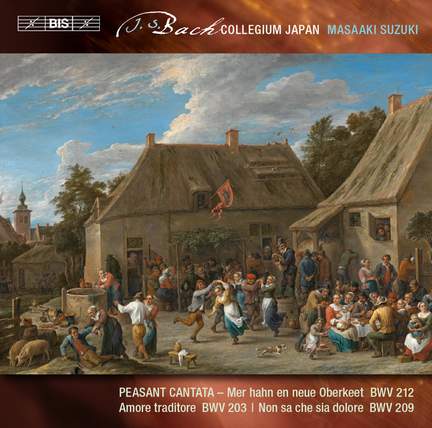
The two voices are ideally cast. Mieke (Mojca Erdmann) sings with a charming simplicity as she resists and then gives way to the advances of her rustic beau, Dominik Wörner. He sings with great...
Bach - Secular Cantatas VII
Mojca Erdmann (soprano), Dominik Wörner (bass), Kiyomi Suga (flute), Nobuaki Fukukawa (horn), Masaaki Suzuki (harpsichord)
Bach Collegium Japan
Purchase product

The two voices are ideally cast. Mieke (Mojca Erdmann) sings with a charming simplicity as she resists and then gives way to the advances of her rustic beau, Dominik Wörner. He sings with great...
About
The works on the seventh disc in Masaaki Suzuki's and Bach Collegium Japan's series of J.S. Bach's secular cantatas are quite special in the composer's production. By far the best-known of them, the so-called 'Peasant Cantata' signals this both through its title (in Upper Saxon dialect) and subtitle ('Cantate burlesque') – composed for a celebration at a country estate outside Leipzig, the soloists in this duo cantata portray neither Roman gods nor allegorical figures but a peasant girl and a farm-hand. In broad dialect, and to music that makes reference to folk songs and village music, the two praise the new owner of the estate and his family, but also work in sly digs at the village parson and the local tax collector. The Peasant Cantata is followed by the only two extant Bach cantatas that set Italian texts. As such, they have been regarded with a certain suspicion by Bach scholars – all the more so as no autograph manuscript has survived of either work. Both works are solo cantatas and both contain a number of surprises for the listener. The longer soprano cantata, BWV 209, is possibly a musical farewell to a young scholar and pupil of Bach’s on his departure from Leipzig after completing his degree. While the opening sinfonia, with concertante flute, sounds like pure Bach the two arias are composed in a style that is strongly influenced by Italian opera. In Amore traditore for bass solo, a disappointed lover takes Amor to task, accusing him of betrayal and deception. It closes with an aria of a quite distinct character, with the harpsichord not appearing as a continuo instrument, but instead taking on a virtuoso, concertante role with toccata-like figurations.
Contents and tracklist
- Mojca Erdmann, Dominik Wörner, Bach Collegium Japan, Kiyomi Suga, Nobuaki Fukukawa
- Masaaki Suzuki
- Recorded: September 2015
- Recording Venue: Hakuju Hall, Tokyo, Japan
- Kiyomi Suga, Mojca Erdmann
- Bach Collegium Japan
- Masaaki Suzuki
- Recorded: September 2015
- Recording Venue: Hakuju Hall, Tokyo, Japan
- Dominik Wörner, Masaaki Suzuki
- Recorded: September 2015
- Recording Venue: Hakuju Hall, Tokyo, Japan
Awards and reviews
 Christmas 2016
The two voices are ideally cast. Mieke (Mojca Erdmann) sings with a charming simplicity as she resists and then gives way to the advances of her rustic beau, Dominik Wörner. He sings with great character, a mischievous inner grin seeming to colour his tone and clarify his diction
 October 2016
Suzuki gets into the swing of this burlesque immediately with deft timing, organic contrasts of bucolic temperament and a winning characterisation of the ‘base and popular’ viewed through a courtly prism. The director’s own keyboard playing adds to the intimate and rolling spontaneity, surely Bach’s most tantalising example of what opera might have afforded him