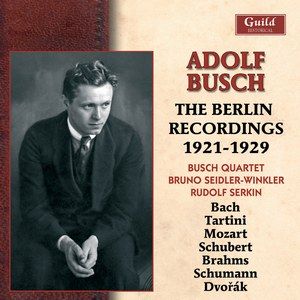
Special offer. Adolf Busch: The Berlin Recordings 1921-1929
Adolf Busch (violin), Bruno Seidler-Winkler (piano)
Busch Quartet, Rudolf Serkin (piano)
There are many good things here. Three Hungarian Dances by Brahms are included. They are exciting performances, delivered with fire and panache. Rubato is subtly applied. The Dvořák Slavonic...
Special offer. Adolf Busch: The Berlin Recordings 1921-1929
Adolf Busch (violin), Bruno Seidler-Winkler (piano)
Busch Quartet, Rudolf Serkin (piano)
Purchase product
There are many good things here. Three Hungarian Dances by Brahms are included. They are exciting performances, delivered with fire and panache. Rubato is subtly applied. The Dvořák Slavonic...
About
For the first time, all the early recordings made in Berlin by the great violinist Adolf Busch are collected in one release. Busch was at his peak in the 1920s and this set, newly transferred direct from the 78rpm originals, includes all the published solos that he recorded for Deutsche Grammophon in 1921-22 - several of them unavailable for eight decades - as well as the first recordings by the legendary Busch Quartet, made in 1922. From the late 1920s come Busch's first records for His Master's Voice, a Bach sonata and Bach's D minor Partita with its great Chaconne, plus two unpublished takes.
Contents and tracklist
- Bruno Seidler-Winkler (piano), Adolf Busch (violin)
- Bruno Seidler-Winkler (piano), Adolf Busch (violin)
- Bruno Seidler-Winkler (piano), Adolf Busch (violin)
- arr. Press
- Bruno Seidler-Winkler (piano), Adolf Busch (violin)
- Bruno Seidler-Winkler (piano), Adolf Busch (violin)
- Bruno Seidler-Winkler (piano), Adolf Busch (violin)
- Bruno Seidler-Winkler (piano), Adolf Busch (violin)
- Bruno Seidler-Winkler (piano), Adolf Busch (violin)
- Bruno Seidler-Winkler (piano), Adolf Busch (violin)
- Bruno Seidler-Winkler (piano), Adolf Busch (violin)
- arr. Corti
- Bruno Seidler-Winkler (piano), Adolf Busch (violin)
- Bruno Seidler-Winkler (piano), Adolf Busch (violin)
- Adolf Busch (violin)
- Adolf Busch (violin)
Awards and reviews
 13th June 2014
There are many good things here. Three Hungarian Dances by Brahms are included. They are exciting performances, delivered with fire and panache. Rubato is subtly applied. The Dvořák Slavonic Dances are similarly vibrant, rhythmical buoyant and exciting. Intonation is always pristine, especially in double-stop passages.