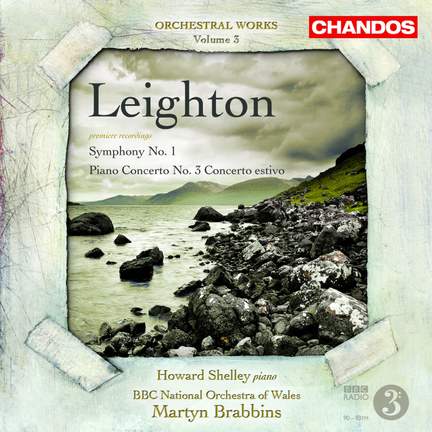
Special offer. Leighton - Symphony No. 1 & Piano Concerto No. 3
Howard Shelley (piano)
BBC National Orchestra of Wales, Martyn Brabbins
Shelley proves a marvellously stylish, involving exponent and is backed to the hilt by Brabbins and the BBC NOW. Chandos's sound and balance, too, are beyond reproach.
Special offer. Leighton - Symphony No. 1 & Piano Concerto No. 3
Howard Shelley (piano)
BBC National Orchestra of Wales, Martyn Brabbins
Purchase product

Shelley proves a marvellously stylish, involving exponent and is backed to the hilt by Brabbins and the BBC NOW. Chandos's sound and balance, too, are beyond reproach.
About
This is the third volume in Chandos’ latest championing of the music of Kenneth Leighton, presenting two further premiere recordings. The previous volume, including Symphony No. 2 (Sinfonia mistica), received tremendous critical acclaim, earning a Rosette in the latest Penguin Guide to Recorded Music. It was a Critic’s Choice in the December 2009 issue of Gramophone, Andrew Achenbach writing: ‘Chandos’ most valuable exploration of Kenneth Leighton’s large-scale output continues with this exhilarating coupling… Miss at your peril.’ International Record Review wrote: ‘I cannot do better than urge this new release on all those with ears to hear. For Leighton’s Sinfonia mistica is, I humbly submit, indeed a masterpiece.’
This latest volume includes the very successful First Symphony, completed in 1964, which won first prize in the 1965 City of Trieste international competition for a new symphonic work. It received its British premiere in October 1967 with the Royal Liverpool Philharmonic Orchestra conducted by Charles Groves. In three movements, it is the only Leighton symphony to employ purely orchestral forces. The composer says that the opening movement ‘sets a mood of elegiac lyricism, and eventually becomes a strong, even desperate protest’, while the second movement, a vibrant scherzo, ‘loosens the reins, and on a spirit of rebellion seeks to arrive at an affirmative answer by sheer force of will’. He describes the final movement as the ‘expressive essence of the symphony… a movement of great beauty’.
The Third Piano Concerto was written in 1968 when the composer succeeded Edmund Rubbra as a fellow of Worcester College, Oxford. Leighton wrote: ‘On the whole the music is more relaxed, more lyrical, and certainly more tonal than that of the previous two piano concertos. And there is also much less emphasis on counterpoint and more on vertical sonorities. Its three movements follow the traditional fast – slow – fast form.’ The central Pastoral evokes ‘the warmth and stillness of a long hot summer afternoon… with a more agitated and dance like central section’. The final movement comprises a set of variations, based on the main theme of the work.
One of the most famous and recorded of pianists in the world today, Howard Shelley receives unanimous critical acclaim for his many recordings, whether on Chandos or other labels. Like the conductor, Martyn Brabbins, he has championed much rarely performed repertoire, this disc being only his his latest example.
Contents and tracklist
Awards and reviews
 August 2010
Shelley proves a marvellously stylish, involving exponent and is backed to the hilt by Brabbins and the BBC NOW. Chandos's sound and balance, too, are beyond reproach.
 July/August 2010
The admirable soloist Howard Shelley...seems utterly attuned to the whole work, both to its percussive aspects and to its delicate filigree writing.