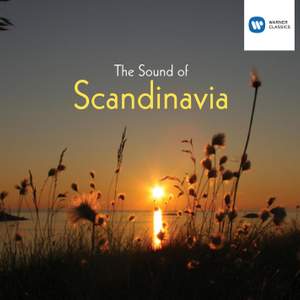
The music of the three countries that make up what we now know as Scandinavia: Norway, Denmark and Sweden, plus Finland, is largely known through the works of just three great composers: the Norwegian Edvard Grieg; The Dane Carl Nielsen and the Swedish-speaking Finn Jean Sibelius.
This set of 6 CDs not only brings together a selection of works by these 'Three Greats', but puts them in the company of some other lesser-known, but no less deserving, composers.
Niels W. Gade (1817-1890) was the most successful Danish composer of his time. His Overture Echoes of Ossian, Op.1 won the prize at a competition set up by the Copenhagen Musical Society. One of the adjudicators there was no less a person than Louis Spohr. More early successes led Gade to Leipzig where he befriended Mendelssohn and Schumann. Upon Mendelssohn's death Gade took over the post of Chief Conductor in Leipzig until, in 1848, he had to return to Copenhagen owing to the Prussian conflict with Denmark. He spent the rest of his life in Copenhagen becoming an influential educationalist and administrator. And it was more through these activities that he was to have a marked influence on the later generation of Danish composers than through his music.
Franz Berwald (1796-1868) was one of the most interesting and unique composers that any country has produced, although he never found proper recognition as a composer in Sweden. After several early setbacks Berwald succeeded in gaining a scholarship abroad and went to Berlin in 1829. There he attempted numerous unsuccessful operatic projects; met Mendelssohn (on whom he made an unfavourable impression) and finally ended up opening a successful orthopaedic institute. The 1840s were Berwald's most productive years and it was during this time that he produced the music on which his present-day reputation rests. In 1841 he moved to Vienna and it was there that he had his most successful time as a composer. Returning to Sweden in 1849 he discovered that his success abroad had no influence on opinion in Sweden and, in 1853, he became part-owner of a glass works in northern Sweden. Berwald's charming Piano Concerto dates from 1855 and so is a comparatively late work. Whilst not quite being one of the composer's best pieces it is a beautifully melodic work that whets the listener's curiosity to find out more about Berwald.
Armas Järnefelt (1869-1958) was a Finnish composer/conductor who mainly worked in Sweden and took Swedish citizenship in 1909. He was Sibelius's brother-in-law. His music is now little known apart from the Praeludium.
Ture Rangström (1884-1947) belonged to a generation of Swedish composers who in the first decade of the 20th century introduced modernism to their compositions. In addition to composing Rangström was also a music critic and conductor. He wrote a good deal of music for the voice and although he produced four symphonies it is as a composer of Swedish song that he is best remembered.
Wilhelm Stennhammar (1871-1927), although being quintessentially a Scandinavian composer, was an admirer of the works of Bruckner, Wagner and Brahms. Beethoven is a strong influence in the six extremely fine string quartets that he wrote between 1894 and 1916 and these works deserve to be heard more often, as do his two symphonies and piano concertos. The Serenade is possibly Stenhammar's masterpiece and is a most charming and subtle work.
Johan Svendsen (1840-1911) was a contemporary of his compatriot Grieg. He spent some time in Paris and Bayreuth, where he worked closely with Wagner. He stopped composing in 1881 and in 1883 took up the position of conductor at the Royal Opera in Copenhagen and became an important figure in the musical life of the Danish capital.
Hans Christian Lumbye (1810-1874) was a Danish composer of polkas, mazurkas, galops and waltzes. Lumbye is best known for his lighter works, many of which evoke non-musical sources. The Champagne Galop, for example, begins with the 'pop' of a champagne cork, and the Copenhagen Steam Railway Galop faithfully recreates the sounds of a train chugging out of a station and grinding to a halt at the next stop. He was greatly influenced by Johann Strauss I and many regarded him as the 'Strauss of the North'.
During his lifetime Hugo Alfvén (1872-1960) was regarded as one the most important composers in Sweden. Many of his works evoke the Swewdish landscape and the first of his Swedish Rhapsodies was so well known in the 1950s that it became something of a light music chart-topper.
The music of Norwegian Christian Sinding (1856-1941) is little known these days, outside of Norway. Even the Rustle of Spring which, in the first half of the 20th century was a popular 'salon' piece, is not played so often. Unfortunately, a few weeks before his death Sinding, by then suffering from senile dementia, was persuaded to become a member of occupying Nazi party. This event has affected his subsequent reputation both abroad and in Norway.
Wilhelm Petersen-Berger (1867-1942) is best known for the three collections of national romantic piano music entitled Frösöblomster, (Flowers of Frösö) the first of which is included in this set and which contains some of the most popular of the pieces.
Lars-Erik Larsson (1908-1986) was one of the most important Swedish composers of the 20th century. His style of composition was eclectic and he composed in many different genres. The two works chosen for this set are among Larsen's most appealing, typically Scandinavian in mood, refined and understated.
Dag Wirén (1905-1986) composed his Serenade for Strings in 1937. It is his best known composition and, along with Alfvén's Midsommarvaka, became the most internationally performed Swedish work. In Britain the Marcia movement achieved wide appeal from it's use by the BBC as the signature tune to a popular TV arts programme.
Artists
Marian Migdal (piano), Barbara Hendricks & Roland Pöntinen, Solveig Kringelborn & Malcolm Martineau, Ingvar Wixell, Leif Ove Andsnes (piano), Albrecht Mayer (oboe) & Markus Becker (piano), John Ogdon (piano), Stig Ribbing, Lucia Popp, Gwyneth Jones
The Royal Danish Orchestra, Royal Philharmonic Orchestra, Bournemouth Symphony Orchestra, Swedish Radio Symphony Orchestra, Trondheim Symphony Orchestra, Copenhagen Tivoli Orchestra, Norwegian Chamber Orchestra, Ambrosian Singers & Academy of St Martin in the Fields, Stockholm Philharmonic Orchestra, Bergen Philharmonic Orchestra, Sveriges Radios Symfoniorchester, Philadelphia Orchestra, London Symphony Orchestra, Hallé Orchestra, Helsinki Philharmonic Orchestra, Johan Hye-Knudsen, Ulf Björlin, Paavo Berglund, Stig Westerberg, Ole Kristian Ruud, Lavard Friisholm, Iona Brown, Neville Marriner, Kenneth Montgomery, Dmitri Kitayenko, Eugene Ormandy, Antal Dorati, Sir John Barbirolli