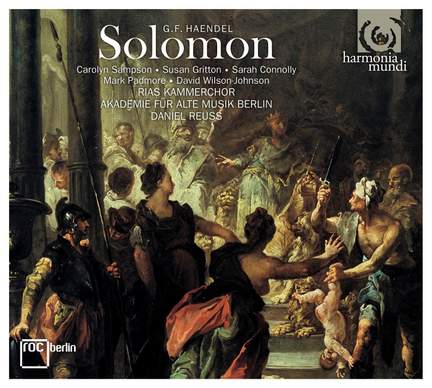
Special offer. Handel: Solomon
Sarah Connolly (mezzo-soprano), Carolyn Sampson (soprano), Susan Gritton (soprano), Mark Padmore (tenor) & David Wilson-Johnson (baritone)
RIAS Kammerchor & Akademie für Alte Musik Berlin, Daniel Reuss
Awards:
-
Gramophone Magazine, December 2007, Editor's Choice

…sleek playing from the Berlin period instrument players, though the choir sounds too slim-line for the big moments. As Zadok, Mark Padmore moves around most of the notes with skill. Sarah...
Special offer. Handel: Solomon
Sarah Connolly (mezzo-soprano), Carolyn Sampson (soprano), Susan Gritton (soprano), Mark Padmore (tenor) & David Wilson-Johnson (baritone)
RIAS Kammerchor & Akademie für Alte Musik Berlin, Daniel Reuss
Purchase product

Awards:
-
Gramophone Magazine, December 2007, Editor's Choice
…sleek playing from the Berlin period instrument players, though the choir sounds too slim-line for the big moments. As Zadok, Mark Padmore moves around most of the notes with skill. Sarah...
About
Handel was 63 years old when he composed Solomon, one of his final masterpieces.The plot is simple with Act 1 dealing with the inauguration of the newly completed temple, and ends with Solomon beckoning his Queen toward the cedar grove, where one suspects it is not just the 'amorous turtles' that 'love beneath the pleasing gloom'. Act II is based around the well known story of two women arguing over who is the mother of the new-born baby, and Solomon's sharp thinking to find a solution and Act III portrays the visit of the Queen of Sheba (also known as the Queen of Egypt and Ethiopia), and her amazement at the glory and splendour of Solomon's court.With a relatively small and diverse cast of characters (Solomon, Queen of Sheba, two Harlots, Zadok the Priest and a Levite) it falls to the chorus, as builders and inhabitants of this 'golden' city, to emphasis the grandeur and splendour of Solomon's kingdom and to literarily provide the pillars of the whole piece. These grand choruses, seven of which are in eight voice parts, add to the texture and opulence of the oratorio mirroring the glory of the court and religious intensity.
This 'perfect marriage of music and English words', as Winton Dean has called it, caused the composer serious financial difficulties in 1749 on account of the exceptional forces it required - but today, under the baton of Daniel Reuss, with an unbeatable British cast, finds a performance totally devoted to its noble cause!
Contents and tracklist
Awards and reviews
-
Gramophone MagazineDecember 2007Editor's Choice
 December 2007
…sleek playing from the Berlin period instrument players, though the choir sounds too slim-line for the big moments. As Zadok, Mark Padmore moves around most of the notes with skill. Sarah Connolly is articulate as Solomon, her carefully measured tone combining warmth with dynamism. Susan Gritton is graceful as Solomon's queen and striking as the First Harlot... But Daniel Reuss's conducting is slack, allowing tempos to drag.
 2010
2010
and Masques (OUP: 1959), Winton Dean advocated the excision of several arias (mainly for the priestly figures of Zadok and the Levite) and the replacement of the closing chorus by the monumental 'Praise the Lord' – a policy followed by John Eliot Gardiner (Philips), though not by the completist Paul McCreesh (Archiv – see above).
In his new recording, Daniel Reuss ditches the final chorus, though he omits just two arias, neither lamented. He also makes puzzling internal cuts in the duet for Solomon and the first harlot, and, more damagingly, the gorgeous opening number of the masque.
That said, the Harmonia Mundi recording is almost unreservedly enjoyable. Abetted by his crack period orchestra and 40-strong chorus, Reuss is responsive alike to the oratorio's ceremonial splendour and its fragrant pastoral tinta. The versions by Gardiner and McCreesh, balanced rather more in favour of the voices, generate an extra weight and sonorous magnificence in the great double choruses. But the vitality and refinement of the Berlin choir is always compelling. With terrific controlled raucousness from antiphonal wind and brass, the opening chorus of Act 2 is as elementally thrilling as it should be. At the other extreme, the Nightingale chorus, taken slowly and secretively, is at least the equal of McCreesh's in drowsy amorous enchantment.
Where the earlier recordings each have at least one unsatisfactory soloist, Reuss's solo line-up could hardly be bettered. Handel cast the role of Solomon with a mezzo-soprano.
Reuss does likewise with Sarah Connolly, who sings with glowing, even tone, ardour (in the love scene), and rapt inwardness in Solomon's two 'nature' arias. Susan Gritton makes a gently sensuous queen (her musing 'With thee th'unshelter'd moor I'd tread' a highlight) and probes the full poignancy and anguish of the first harlot's music. While yielding to Della Jones (Gardiner) and Susan Bickley (McCreesh) in sheer venom, Carolyn Sampson characterises with gusto as the second harlot, and beautifully softens her bright, vernal tone in 'Will the sun forget to streak?' The priests are in the expert hands of Mark Padmore (exemplary in his bouts of coloratura) and the gravely sonorous David Wilson-Johnson.
If you want this magnificent work complete, McCreesh's is the version to go for, while for consistently glorious Handel singing the new Harmonia Mundi recording, impressively directed by Reuss, takes the palm.
 December 2007
Abetted by his crack period orchestra and 40-strong chorus, Reuss is responsive alike to the oratorio's ceremonial splendour and its fragrant pastoral tinta. …the vitality and refinement of the Berlin choir is always compelling. With terrific controlled raucousness from antiphonal wind and brass, the opening chorus of Act 2 is an elementally thrilling as it should be. At the other extreme, the Nightingale chorus, taken slowly and secretively, is at least the equal of McCreesh's in drowsy amorous enchantment. ...Reuss's solo line-up could hardly be bettered. Handel cast the role of Solomon with a mezzo-soprano. Reuss does likewise with Sarah Connolly, who sings with glowing, even tone, ardour (in the love scene), and rapt inwardness in Solomon's two "nature" arias.