

Sheet Music Downloads: Delivery is currently taking longer than usual. We’re working to restore instant access as soon as possible. Audio downloads are processing as normal.
Andriessen, L: Writing to Vermeer
Susan Bickley (mezzo-soprano), Barbara Hannigan (soprano), Susan Narucki (soprano)
ASKO Ensemble, Schoenberg Ensemble, De Nederlandse Opera, Reinbert de Leeuw
Andriessen's score has its own internal symmetries and conceits - there are references to folk songs and to works by Sweelinck and John Cage. But its most striking characteristics are the sheer...
Andriessen, L: Writing to Vermeer
Susan Bickley (mezzo-soprano), Barbara Hannigan (soprano), Susan Narucki (soprano)
ASKO Ensemble, Schoenberg Ensemble, De Nederlandse Opera, Reinbert de Leeuw
Purchase product

Andriessen's score has its own internal symmetries and conceits - there are references to folk songs and to works by Sweelinck and John Cage. But its most striking characteristics are the sheer...
About
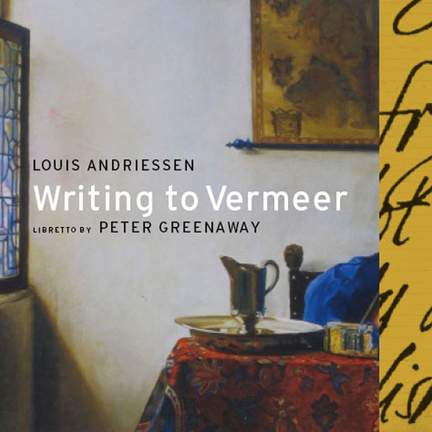
Nonesuch Records releases Writing to Vermeer, an opera with music by Louis Andriessen and libretto by Peter Greenaway. Reinbert de Leeuw conducts the Asko Ensemble and Schönberg Ensemble, with soloists soprano Susan Narucki (Catharina Bolnes), mezzo soprano Susan Bickley, (Maria Thins), and soprano Barbara Hannigan (Saskia de Vries), along with the children’s choir, De Kickers, from Amsterdam’s Muziekschool Waterland, a women’s chorus, and Michel van der Aa’s electronic music inserts.
Writing to Vermeer was given its world premiere by De Nederlandse Opera in 1999 at Het Muziektheater in Amsterdam, in a production co-directed by Greenaway and Saskia Boddeke; it was first heard in the U.S. at the 2000 Lincoln Center Festival.
The opera is set in 1672, the year Dutch history books describe as “The Year of Disaster.” France, England, and the German bishoprics of Munster and Cologne declared war against the Netherlands and conquered large parts of the country. The dikes were breached, and the Prince of Orange retreated behind the water defense line around the western province of Holland. Trade and industry came to a standstill. It was the largest financial crash in the Dutch Republic’s short history and marked the end of the Dutch Golden Age. The opera ends in a deluge depicting the last desperate act of the Dutch to keep their country from invasion: the breaking of the dikes. Peter Greenaway, who had long been fascinated by Johannes Vermeer, based Writing to Vermeer on a series of fictitious letters addressed to the painter from three women: his real mother-in-law and his real wife, and a model (a fictional character). The letters are sent to the painter in May 1672, when he had traveled to The Hague to attempt to authenticate several dubious Italian paintings purchased by the Grand Elector of Brandenburg. The opera explores the stark contrast between the serene domestic world of Vermeer’s life and paintings, with their tasteful distilled interiors, and the turbulent events of the time.
Contents and tracklist
- Louis Andriessen, Barbara Hannigan (soprano), Susan Bickley (mezzo-soprano), Susan Narucki (soprano)
- Asko Ensemble, Schönberg Ensemble
- Reinbert de Leeuw
Awards and reviews
 May 2006
Andriessen's score has its own internal symmetries and conceits - there are references to folk songs and to works by Sweelinck and John Cage. But its most striking characteristics are the sheer beauty of the sound world in which strings are far more prominent than in any other of his works, and the always lucid, elegant word setting, while orchestral interludes and electronic interjections introduce the violence and stridency of a country preparing for war. On disc, conducted with perfect tact and accuracy by Reinbert de Leeuw with Susan Narucki, Susan Bickley and Barbara Hannigan all outstanding as the letter-writing females, there is a natural balance between all these elements...
 June 2006
Vermeer opens with quiet, transparent scoring like rays of sun at dawn in the endless of sky of a Dutch landscape. But gradually darkness encroaches; the score is permeated with sombre textures from low strings and woodwind, and is finally overcome by a wave of electronically altered voices and instruments. Altogether absorbing, with commendable performances all round.
