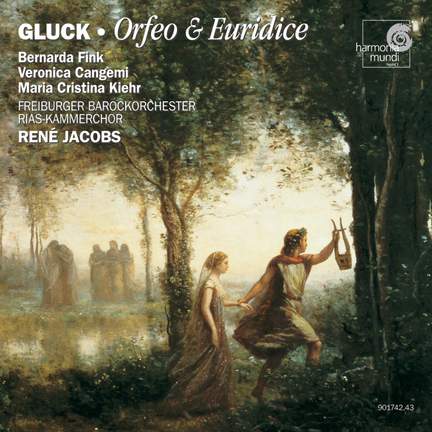
Special offer. Gluck: Orfeo ed Euridice
Bernarda Fink (Orfeo) Veronica Cangemi (Euridice), Maria Cristina Kiehr (Amor)
Freiburger Barockorchester & Rias Kammerchor, René Jacobs
Awards:
-
Building a Library, March 2003, First Choice

Jacobs conducts an urgent, pungently characterised performance
Special offer. Gluck: Orfeo ed Euridice
Bernarda Fink (Orfeo) Veronica Cangemi (Euridice), Maria Cristina Kiehr (Amor)
Freiburger Barockorchester & Rias Kammerchor, René Jacobs
Purchase product

We pay more royalties to artists and composers than any other streaming service with our innovative Fair Play pay-per-second model
We pay artists and composers fairly with our pay-per-second model
Awards:
-
Building a Library, March 2003, First Choice
Jacobs conducts an urgent, pungently characterised performance
About
Contents and tracklist
Act II, Scene 1, Coro e Orfeo: Ah! Quale incognito -Men tiranne ah, voi sareste - Ah! Quale incognito
Track length3:11
Awards and reviews
 April 2009
Jacobs conducts an urgent, pungently characterised performance
 2010
2010
Orfeo comes in many guises. There's Gluck's original Italian version, composed for Vienna in 1762, his adjusted version for Parma in 1769, his French revision of 1774 for Paris, and then the numerous, posthumous compromise texts that seek the best of both worlds by incorporating sections of the French version within the framework of the Italian. This version is 'pure' Italian, and although this means forgoing such famous and affecting music as the Dance of the Blessed Spirits, 'Cet asile' and the enhanced ending to 'Che farò', as well as the big D minor Dance of the Furies, it does offer a much more concentrated experience.
The tone of the performance is set by the highly energetic overture, with its forceful accents and its sharply defined textures and dynamics. Jacobs takes pains throughout to give a clear yet also rich quality to Gluck's highly original orchestral textures and to shape his phrases with style and awareness of the omnipresence of dance. However, it's the singer of Orpheus, even more than the conductor, who gives character to a performance of this work.
Often nowadays it's sung by a countertenor in preference to the contralto long favoured in the role, which was composed for a castrato anyway.
So which voice better suits the semi-divine Orpheus? Ultimately it depends on the artistry of the singer. Bernarda Fink sings the role here very beautifully and quite unaffectedly. Her great strength lies in her smooth, natural and very even tone and her command of line.
This is probably the best version of the Italian original with a woman as Orpheus, and can be recommended without hesitation to anyone who prefers to avoid the male alto voice. If you prefer to stick with the male voice the choice lies between Michael Chance's beautifully sung version under Frieder Bernius (Sony) and Derek Lee Ragin's ardent impersonation in Gardiner's account; both are revealing, in quite different ways, of this very special work.