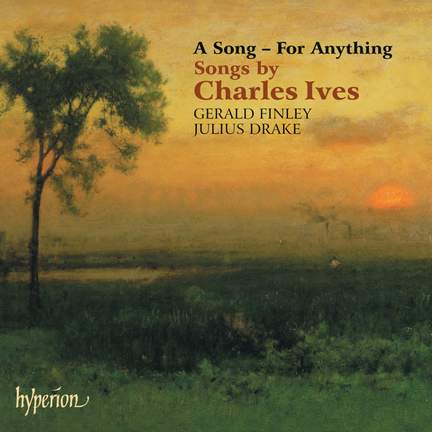
A Song For Anything
Songs by Charles Ives
Gerald Finley (baritone) & Julius Drake (piano)
The Canadian baritone Gerald Finley has a voice of great beauty, but it's always under the control of his penetrating intelligence: he risks bending pitches for expressive effect, and he adapts...
A Song For Anything
Songs by Charles Ives
Gerald Finley (baritone) & Julius Drake (piano)
Purchase product

The Canadian baritone Gerald Finley has a voice of great beauty, but it's always under the control of his penetrating intelligence: he risks bending pitches for expressive effect, and he adapts...
About
Charles Ivess work as a pioneering polytonalist is perhaps better remembered today than his song output, but throughout his long composing life his most personal musical expressions are to be found in what may best be called the genre of the art song. These range from traditional lieder (setting such familiar poets as Heinrich Heine and Nikolaus Lenau), through English-language songs of the period (Kipling, Keats, Bulwer-Lytton), to pioneering pop songs in the modern idiom, often to texts of Ivess own devising. All show a degree of craftsmanship which makes one wonder why many of these songs are not better known. Ives admitted to a deep mistrust of singerstheir insistence on interpreting any given score frequently, he felt, betrayed its composers intentions: not so with Gerald Finley and Julius Drake. These peformances perfectly encapsulate a lost world, transporting the listener back to a world where a sentimental ballad could happily share the stage with a pastiche on the Battle Cry for Freedom. This is Gerald Finleys first solo recital recording.
Contents and tracklist
Awards and reviews
 September 2005
The Canadian baritone Gerald Finley has a voice of great beauty, but it's always under the control of his penetrating intelligence: he risks bending pitches for expressive effect, and he adapts his golden timbre and almost English diction to the childlike tones of The Greatest Man and the cowboy drawl of Charlie Rutlage. Julius Drake is an equally versatile pianist, adept alike in simplicity and complexity.
 2010
2010
These songs, drawn from Ives's 200, can encourage at one extreme a rough declamatory style and at the other an almost voiceless intimacy.
Without in any way underplaying, Finlay is always essentially a singer – his tone and command of the singing line are a pleasure in themselves. But he also has the absolute mastery of the composer's idioms and, with Julius Drake, his fearless and totally committed pianist, the technical, virtuosic skills to realise his intentions with (amid all the quirks) complete conviction of naturalness.
This is a selection that very satisfactorily balances early and late, rumbustious and contemplative.
Several of the early German settings are included, always beautiful and always develop- ing with some touch that is entirely personal. Of a quite distinctive beauty are those like Remembrance, Berceuse, and The Housatonic at Stockbridge where voice and piano work a dreamy, misty spell. And still more characteristic are the settings of his own verses evoking memories of childhood. The 'character' songs (such as Charlie Rutlage) and the 'big' numbers (GeneralWilliam Booth Enters into Heaven) become less prominent than they commonly seem in a recital group where they are programmed as an effective tour de force. The total impression is of an astonishing individuality and, more importantly, of a completely honest, dauntless and increasingly to be valued musical identity.