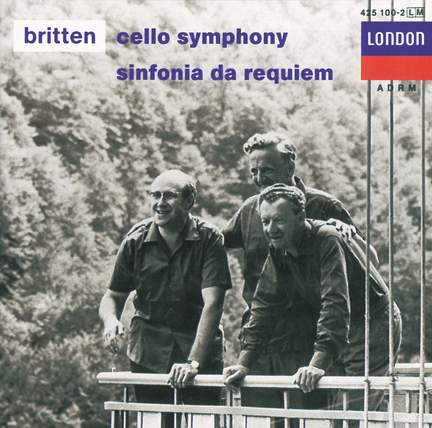
Britten: Cello Symphony and Other Works
Mstislav Rostropovich (cello), Peter Pears (tenor), Dietrich Fischer-Dieskau (baritone)
New Philharmonia Orchestra, English Chamber Orchestra, Benjamin Britten
Awards:
-
Building a Library, March 2005, First Choice

-
Building a Library, June 2017, First Choice
The Cello Symphony, written in 1963 as part of a series for the great Russian cellist Mstislav Rostropovich, was the first major sonata-form work written since the Sinfonia. The idea of a struggle...
Britten: Cello Symphony and Other Works
Mstislav Rostropovich (cello), Peter Pears (tenor), Dietrich Fischer-Dieskau (baritone)
New Philharmonia Orchestra, English Chamber Orchestra, Benjamin Britten
Purchase product

We pay more royalties to artists and composers than any other streaming service with our innovative Fair Play pay-per-second model
We pay artists and composers fairly with our pay-per-second model
Awards:
-
Building a Library, March 2005, First Choice
-
Building a Library, June 2017, First Choice
The Cello Symphony, written in 1963 as part of a series for the great Russian cellist Mstislav Rostropovich, was the first major sonata-form work written since the Sinfonia. The idea of a struggle...
About
Contents and tracklist
- Mstislav Rostropovich (cello)
- English Chamber Orchestra
- Benjamin Britten
- Recorded: 1964-07-18
- Recording Venue: Kingsway Hall, London
- New Philharmonia Orchestra
- Benjamin Britten
- Recorded: 1964-12-18
- Recording Venue: Kingsway Hall, London
- Peter Pears (tenor), Dietrich Fischer-Dieskau (baritone)
- London Symphony Chorus, London Symphony Orchestra
- Benjamin Britten
- Recorded: 1963-12-14
- Recording Venue: Kingsway Hall, London
Spotlight on this release
-
Benjamin Britten
24th Mar 2014
Presto’s founder Maurice Millward sifts through a treasure-chest of Britten recordings and offers his thoughts on which paint the best portrait of this influential genius.

Awards and reviews
 2010
2010
The Cello Symphony, written in 1963 as part of a series for the great Russian cellist Mstislav Rostropovich, was the first major sonata-form work written since the Sinfonia. The idea of a struggle between soloist and orchestra, implicit in the traditional concerto, has no part here; it's a conversation between the two. Rostropovich plays with a depth of feeling that has never quite been equalled in other recordings and the playing of the English Chamber Orchestra has great bite. The recording, too, is extraordinarily fine for its years.
From the opening drumbeat the Sinfonia employs a sonata form with dramatic power, although the tone is never fierce or savage; it has an implacable tread and momentum. The central movement, 'Dies irae', however, has a real sense of fury, satirical in its biting comment – the flutter-tongued wind writing rattling its defiance.
The closing 'Requiem aeternam' is a movement of restrained beauty. The New Philharmonia play superbly. The Cantata misericor-dium was written in 1962 as a commission from the Red Cross. It takes the story of the Good Samaritan and is scored for tenor and baritone soloists, chorus, string quartet and orchestra. It's a universal plea for charity and receives a powerful reading. A must for any Britten enthusiast.
 March 2014
Landmark performances of three lesser-known works by their dedicatees... The early Sinfonia da Requiem (written when Britten was just 26) is distinguished by the visceral playing of the New Philharmonia. Britten himself conducts dramatic and powerful readings of all three works.