Beethoven - Complete Symphonies
Luba Orgonasova, Anne Sofie von Otter, Anthony Rolfe Johnson, Gilles Cachemaille
The Monteverdi Choir & Orchestre Révolutionnaire et Romantique, John Eliot Gardiner
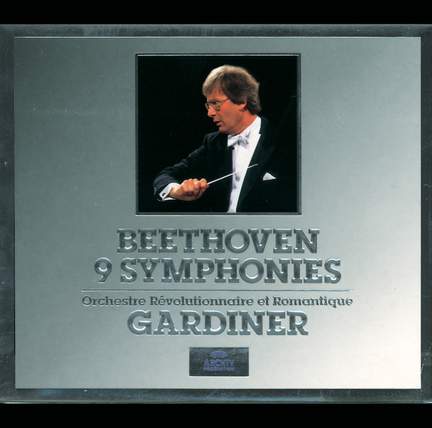
This set is remarkable and many will rate it as Mr Knightley rates Emma Woodhouse 'faultless in spite of her faults'. In his booklet essay, Peter Czorny tells us that the recordings are offered...
Beethoven - Complete Symphonies
Luba Orgonasova, Anne Sofie von Otter, Anthony Rolfe Johnson, Gilles Cachemaille
The Monteverdi Choir & Orchestre Révolutionnaire et Romantique, John Eliot Gardiner
Purchase product

We pay more royalties to artists and composers than any other streaming service with our innovative Fair Play pay-per-second model
We pay artists and composers fairly with our pay-per-second model
This set is remarkable and many will rate it as Mr Knightley rates Emma Woodhouse 'faultless in spite of her faults'. In his booklet essay, Peter Czorny tells us that the recordings are offered...
About
Contents and tracklist
- Orchestre Révolutionnaire et Romantique
- Sir John Eliot Gardiner
- Recorded: 1993-03-28
- Recording Venue: "The Maltings", Concert Hall, Snape
- Orchestre Révolutionnaire et Romantique
- Sir John Eliot Gardiner
- Recorded: 1991-11-07
- Recording Venue: Great Hall, Blackheath Concert Halls, London
- Orchestre Révolutionnaire et Romantique
- Sir John Eliot Gardiner
- Recorded: 1993-03-28
- Recording Venue: "The Maltings", Concert Hall, Snape
- Orchestre Révolutionnaire et Romantique
- Sir John Eliot Gardiner
- Recorded: 1993-03-20
- Recording Venue: All Hallows, Gospel Oak, London
- Stephan Flock (videoscripteditor), Rainer Hebborn (videoscripteditor), Mark Buecker (videoscripteditor)
- Orchestre Révolutionnaire et Romantique
- Sir John Eliot Gardiner
- Recorded: 1994-03-18
- Recording Venue: Palau De La Musica, Barcelona
- Ingmar Haas (videoscripteditor), Mark Buecker (videoscripteditor)
- Orchestre Révolutionnaire et Romantique
- Sir John Eliot Gardiner
- Recorded: 1992-10-20
- Recording Venue: All Saints Church, London
I. Erwachen heiterer Empfindungen bei der Ankunft auf dem Lande: Allegro ma non troppo
Track length11:13
- Orchestre Révolutionnaire et Romantique
- Sir John Eliot Gardiner
- Recorded: 1992-12-20
- Recording Venue: All Hallows, Gospel Oak, London
- Orchestre Révolutionnaire et Romantique
- Sir John Eliot Gardiner
- Recorded: 1992-12-20
- Recording Venue: All Hallows, Gospel Oak, London
- Luba Orgonasova (soprano), Anne Sofie von Otter (mezzo-soprano), Anthony Rolfe Johnson (tenor), Gilles Cachemaille (bass)
- Orchestre Révolutionnaire et Romantique, Monteverdi Choir
- Sir John Eliot Gardiner
- Recorded: 1992-10-20
- Recording Venue: All Saints Church, London
Awards and reviews
 2010
2010
This set is remarkable and many will rate it as Mr Knightley rates Emma Woodhouse 'faultless in spite of her faults'. In his booklet essay, Peter Czorny tells us that the recordings are offered in the hope of transporting the listener back 'to that moment when this music burst forth into a world of heroes, wars and revolution, creating its own world of the sublime and ineffable'. This theme is developed by Gardiner in a robust 20-minute talk on the project that comes free on a sixth CD. Gardiner's opinion that Beethoven wanted his musicians to live dangerously has some peculiar consequences.
Symphony No 1: The opening is superbly judged. Gardiner doesn't overplay the Adagiomolto, and the Allegro con brio, often played with a fatal languor by members of the old German School, is pretty quick. After his absurdly brisk reading of the second movement, Gardiner goes on to conduct dazzlingly successful accounts of the Scherzo and finale. Symphony No 2: This is very fine throughout. By following the written tempo markings and his own musical instincts Gardiner produces a perfomance of the first movement that opens out the drama most compellingly.
Symphony No 3: More révolutionnaire than romantique. A very fast first movement gets within spitting distance of an impossible metronome mark. That and keen texturing make for tremendous dramatic urgency. Unfortunately, there's also too little accommodation en route of the rich cargo of ideas that Beethoven has shipped into this movement. In their haste to get to the recapitulation itself, Gardiner and his players are decidedly unpoised. He's superb in the last two movements; but these are considerably less than half the story where the Eroica is concerned. Symphony No 4: An unusually quick introductory and brisk Allegro vivace. Gardiner treats the pivotal drum entry before the recapitulation atmospherically. Glorious slow movement, impossibly quick finale.
Symphony No 5: Here is the stuff of which revolutions are made. Gardiner plays the piece pretty straight, and at white heat. The orchestra is superb, helped by the Francophone bias of its sound base. That said, the Scherzo (with repeat) is surely too fast. It starts briskly and not especially quietly. The pace drops back for the Trio, which is just as well since the strings are hardpressed to articulate clearly. The finale is also very fast, again ahead of what's generally regarded as a good metronome. There's a grandeur to the Scherzo-cum-finale that could be seen to reflect a vision that transcends the politics of revolution. Still, for its éclat terrible, this is unbeatable. The slow movement is also superbly shaped and directed.
Symphony No 6: Despite some lovely playing in the slow movement and an air of brisk efficiency, this is a rather joyless Pastoral. Nor is it a spiritually uplifting one. The Scherzo – 'A merry gathering of country folk' – is a very high-speed affair. At such a pace the various amusing false entries rather lose their point; to play in this village band you would need to be a virtuoso, and teetotal to boot.
Symphony No 7: A glorious performance. The introduction sets the scene with an ideal blend of weight and anticipation. The Vivace has a splendid dance feel and a power that's wholly unforced. Scherzo and finale are also superbly paced. The Allegretto is eloquent with a sense of barely sublimated grieving. The recording is magnificent. Symphony No 8: In general, the symphony thrives on the Gardiner approach, though in the finale the emphasis is again on high-speed locomotion.
Symphony No 9: The first movement has never been dispatched as rapidly as here. In fact, Gardiner doesn't get the bit between the teeth until bar 51, so the celebrated introduction has room to breathe. But he isn't entirely inflexible, and he and his players show remarkable skill in making busy detail tell. Yet a lot does go by the board. The slow movement is also played very quickly. However, the finale is superb. Tempos are unerringly chosen, the choral singing is beyond criticism, and there's a rare expressive quality to the singing of the solo quartet. High quality playing from the orchestra and often exceptional Archiv sound. At best, the physical and intellectual vitality of this music-making brings us close to the Ding an sich'. It's a best that occurs only intermittently. That it occurs at all is perhaps a sufficient miracle.