Special offer. The Haydn Mass Edition - Große Orgelmesse
Susan Gritton (soprano), Louise Winter (mezzo-soprano), Mark Padmore (tenor), Stephen Varcoe (bass), Ian Watson (organ)
Collegium Musicum 90, Richard Hickox
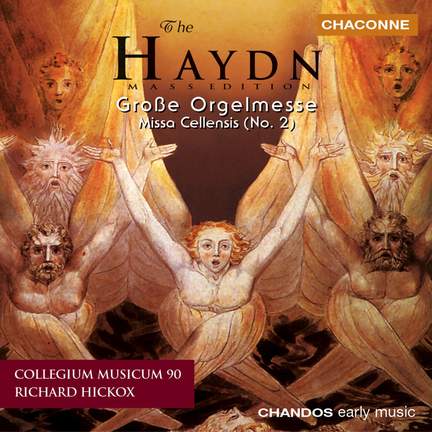
This concluding issue in Richard Hickox's prize-winning Haydn Mass series follows a similar pattern to earlier discs, offering exhilarating performances which wear their period style lightly....
Special offer. The Haydn Mass Edition - Große Orgelmesse
Susan Gritton (soprano), Louise Winter (mezzo-soprano), Mark Padmore (tenor), Stephen Varcoe (bass), Ian Watson (organ)
Collegium Musicum 90, Richard Hickox
Purchase product

We pay more royalties to artists and composers than any other streaming service with our innovative Fair Play pay-per-second model
We pay artists and composers fairly with our pay-per-second model
This concluding issue in Richard Hickox's prize-winning Haydn Mass series follows a similar pattern to earlier discs, offering exhilarating performances which wear their period style lightly....
About
Contents and tracklist
- Collegium Musicum 90, Richard Hickox, Susan Gritton, Louise Winter, Mark Padmore, Stephen Varcoe, Ian Watson, Collegium Musicum 90 Choir
- Richard Hickox, Collegium Musicum 90, Susan Gritton, Louise Winter, Mark Padmore, Stephen Varcoe, Ian Watson, Collegium Musicum 90 Choir
Awards and reviews
 2010
2010
This concluding issue in Richard Hickox's prize-winning Haydn Mass series follows a similar pattern to earlier discs, offering exhilarating performances which wear their period style lightly. Gardiner for Philips is by a fraction the more crisply incisive, with pinpoint attack and clean textures: Hickox generally prefers slightly broader speeds, with full, immediate sound, more clearly bringing out the joy of Haydn's inspiration as well as the drama.
Both of these Masses are relatively neglected, even on disc. The Great Organ Mass, dating from 1768-9, seems not to have been composed for a special occasion, but, exceptionally, because Haydn wanted to write it. It's a distinctive work, both in its choice of key, E flat, rare for a Mass of the time, and for replacing oboes in the orchestra with two cor anglais.
The role of the organ is far more important, though; its Baroque figuration attractively decorative, while the Benedictus includes a concertante organ part, accompanying the quartet of soloists. Choosing light registration, Ian Watson produces delightful sounds throughout, with delicate organ decorations set in contrast with the relatively plain choral writing. As in the rest of the Hickox series, the singing and playing of Collegium Musicum 90 is most stylish.
Hickox has a special relish for Haydn's rhythmic exuberance, as in the syncopated Amens in the Sanctus and the robust 6/8 rhythms of the 'Dona nobis pacem' at the very end.
The Mariazeller Mass, written much later in 1782, was the last Mass setting that Haydn composed before the final six masterpieces, and already points forward. As in those late Masses, the Kyrie is in a compressed sonata form: a slow introduction leads to a vigorous Allegro, with the 'Christe eleison' as the development section.
Clearly, Haydn was already thinking of his Mass settings in symphonic terms, with striking keychanges also relating to Haydn's symphonic writing.
Even more than in the Great Organ Mass, Hickox brings out the vitality of the writing, as in the extraordinary 'Dona nobis pacem' at the end, so wildly syncopated it's almost jazzy. A splendid culmination to an outstanding series.