Routledge International Handbook of Music Psychology in Education and the Community
- Editor: Creech, Andrea
- Editor: Hallam, Susan
- Editor: Hodges, Donald
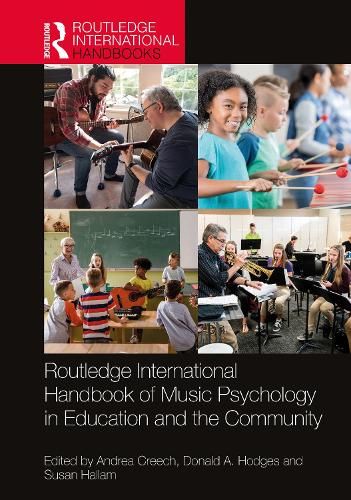
Routledge International Handbook of Music Psychology in Education and the Community
- Editor: Creech, Andrea
- Editor: Hallam, Susan
- Editor: Hodges, Donald
Purchase product
About
This handbook provides an evidence-based account of psychological perspectives on issues in music education and music in the community through the life course, exploring our understanding of music learning and participation across contexts.
The contributors draw on multidisciplinary research from different cultures and contexts in order to set out the implications of music psychology for music education and music in the community. Highlighting the intersecting issues across education and community contexts, the book proposes new theories as well as offering important refinements to existing conceptual models. Split into six parts, it considers the role of music in society as well as for groups and individuals, and explores topics such as processing and responding to music; pedagogical and musical practices that support or pose challenges to the emotional, cognitive, social or physical wellbeing of learners and participants in a range of contexts; and ‘music in identity’ or ‘identity in music’. With the final part on future directions and the implications for professional practice in music education and music in the community, the book concludes by exploring how the two sectors might work more closely together within a post-COVID-19 world.
Based on cutting-edge research from an international team, this is essential reading for anyone interested in music psychology, education and community, and it will be particularly helpful for undergraduate and graduate students in music psychology, music education and community music.
Contents
- PART I Introduction and context
- Introduction
- Andrea Creech and Donald A. Hodges
- 1 The social functions of music: Communication, Wellbeing, Art, Ritual, Identity and Social networks (C- WARIS)
- Raymond MacDonald
- 2 Ruminations on music psychology research
- Donald A. Hodges
- 3 The wider cognitive benefi ts of engagement with music
- Sylwia Holmes
- 4 The wider personal and social benefi ts of engagement with music
- Albi Odendaal and Donald A. Hodges
- 5 The health benefi ts of engaging with music
- Gunter Kreutz and Urs Nater
- PART II Processing and responding to music 81
- Introduction
- Andrea Creech and Donald A. Hodges
- 6 Musical processing across the life course
- Wilfried Gruhn
- 7 Responses to music
- Robert Fulford, Alinka Greasley and Karen Burland
- 8 Listening to, evaluating and appraising music
- Alexandra Lamont
- 9 Musical preferences
- Alexandra Lamont and David Hargreaves
- PART III Acquiring specifi c music skills
- Introduction
- Donald A. Hodges and Andrea Creech
- 10 Conceptions of musical ability and the expertise paradigm
- Jane W. Davidson and Stephanie MacArthur
- 11 Transformational models of music learning
- Maria Varvarigou and Andrea Creech
- 12 Learning to play an instrument
- Katie Zhukov
- 13 Through singing to music across the life course
- Annabel J. Cohen
- 14 Acquiring skills in music technology
- Ross Purves and Evangelos Himonides
- 15 Community music learning and creativity
- Beatriz Ilari, Susan Helfter and Peter Webster
- 16 Motivation and developing a musical identity
- Maria Spychiger
- 17 The role of music performance through the life course
- Ioulia Papageorgi
- 18 Health issues for those participating in musical activities
- Bronwen Ackermann
- PART IV Pedagogy in education and community music
- Introduction
- Donald A. Hodges and Andrea Creech
- 19 Music pedagogy for large group teaching: The conductor-educator
- Wendy K. Matthews
- 20 Working with and in small groups
- Elaine King
- 21 Musical engagement in one- to- one contexts
- Helena Gaunt, Guadalupe L o pez- I n iguez and Andrea Creech
- 22 Additional needs and disability in musical learning: Issues and pedagogical considerations
- David Baker
- 23 Holding multiple musical identities: The portfolio musician
- Jennifer Rowley, Anna Reid and Dawn Bennett
- 24 The role of formative and summative assessment in musical learning and participation
- Mathieu Boucher and Andrea Creech
- PART V Support for musical learning
- Introduction
- Donald A. Hodges and Andrea Creech
- 25 The role of the family in supporting musical learning
- Stephen F. Zdzinski
- 26 The role of peers in supporting learning in music
- Siw Graabr ae k Nielsen and Guro Gravem Johansen
- 27 The role of technology in mediating collaborative learning in music
- Aaron Liu- Rosenbaum and Andrea Creech
- PART VI Future directions
- Introduction
- Donald A. Hodges and Andrea Creech
- 28 Implications for research and practice 1
- Donald A. Hodges and Andrea Creech
- 29 Implications for research and practice 2
- Andrea Creech and Donald A. Hodges