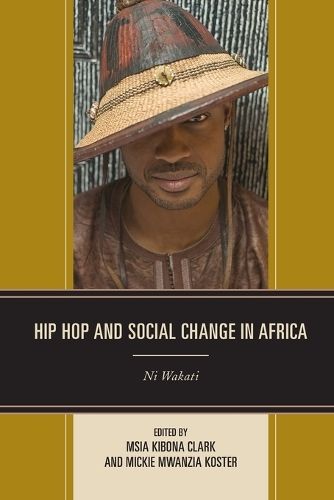
Hip Hop and Social Change in Africa: Ni Wakati
- Editor: Clark, Msia Kibona
- Editor: Koster, Mickie Mwanzia
In recent years, several books have been published concerning African hip-hop, including Eric Charry’s Hip-hop Africa: New African Music in a Globalizing World (2012) and Mwenda Ntarangwi’s...
Hip Hop and Social Change in Africa: Ni Wakati
- Editor: Clark, Msia Kibona
- Editor: Koster, Mickie Mwanzia
Purchase product
Other available formats

In recent years, several books have been published concerning African hip-hop, including Eric Charry’s Hip-hop Africa: New African Music in a Globalizing World (2012) and Mwenda Ntarangwi’s...
About
This book examines social change in Africa through the lens of hip hop music and culture. Artists engage their African communities in a variety of ways that confront established social structures, using coded language and symbols to inform, question, and challenge. Through lyrical expression, dance, and graffiti, hip hop is used to challenge social inequality and to push for social change. The study looks across Africa and explores how hip hop is being used in different places, spaces, and moments to foster change. In this edited work, authors from a wide range of fields, including history, sociology, African and African American studies, and political science explore the transformative impact that hip hop has had on African youth, who have in turn emerged to push for social change on the continent. The powerful moment in which those that want change decide to consciously and collectively take a stand is rooted in an awareness that has much to do with time. Therefore, the book centers on African hip hop around the context of “it’s time” for change, Ni Wakati.
Contents
- 1. Introduction by Msia Kibona Clark and Mickie Mwanzia Koster
- Part I: “Social Ills”: Coming from Behind the Microphone to Effect Reform in Africa
- 2. Hip-Hop Halisi: Continuities of Heroism on the African Political Landscape, Caroline Mose
- 3. Building Our Nation: Sénégalese Hip Hop Artists as Agents of Social and Political Change, Sheba Lo
- 4. Speaking Truth to Power: Hip-Hop and the African Awakening, Amentahru Wahlrab
- Essay 1 English. “Malian Hip Hop: Social Engagement through Music,” Amkoullel L'enfant Peulh
- Part II: “The Dusty Foot Philosopher”: Hip Hop Voices on Social Change in Africa
- Essay 2. “How Hip Hop Impacts Social Change in Africa,” Malle Marxist
- 5. Redefining the Struggle: Remembering the Mau Mau through Hip-Hop Music, Mich Nyawalo
- 6. Khoi Hop: Hip Hop, Youth Activism and the Dilemma of Coloured Identity in South Africa, Shaheen Ariefdien and Rico Chapman
- 7. Beyond “Y’en a Marre”: Pikine’s Hip Hop Youth Say “Enough is Enough” and Pave the Way for Continuous Social Change, Asl
Awards and reviews

In recent years, several books have been published concerning African hip-hop, including Eric Charry’s Hip-hop Africa: New African Music in a Globalizing World (2012) and Mwenda Ntarangwi’s East African Hip-hop: Youth Culture and Globalization. While these books tackle some aspects of the societal implications of the music genre, they tend to focus on globalization, youth culture, or the music alone. The work under review is sharply focused on a critical examination of hip-hop and social change, whether by political and social commentary or by actually changing traditions and behavior. Furthermore, the book is unique in that it blends essays written by scholars as well as by some African hip-hop artists themselves, which allows for an exploration of the topic from both academic and firsthand perspectives. . . .The essays are thoughtful, insightful, and well written. All academic libraries with substantive African studies and/or world music collections. Summing Up: Highly recommended. All levels/libraries