

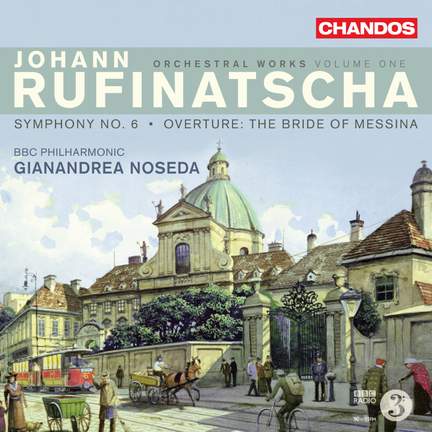
Johann Rufinatscha: Orchestral Works Volume 1
Premiere recordings
BBC Philharmonic, Gianandrea Noseda
Rufinatscha evidently had a gift for a melody full of sunshine. This hour-long D major symphony (his last, from 1865) is full of them
Johann Rufinatscha: Orchestral Works Volume 1
Premiere recordings
BBC Philharmonic, Gianandrea Noseda
Purchase product

Rufinatscha evidently had a gift for a melody full of sunshine. This hour-long D major symphony (his last, from 1865) is full of them
About
This is Volume 1 of a planned series of three, bringing to life the rarely heard but colourful music of the Austrian composer Johann Rufinatscha. The works presented here have never been recorded before, and are performed by the BBC Philharmonic Orchestra under Gianandrea Noseda, an exclusive Chandos artist – a partnership of long standing, noted for the precision and fullness of their sound as well as for the strength of their musical interpretations.
Although very little is known of Johann Rufinatscha today, in his time he held an established place in Vienna’s highest musical circles and enjoyed considerable acclaim for his orchestral, chamber, and piano works, some even predicted for him a stellar future. He was a respected teacher and a great friend of Brahms who was not a man to suffer musical fools gladly. The music of Rufinatscha, represented here by two later works, is rich and dramatic, with expressively charged melodies running throughout. His orchestral works are ambitious in scale, strong in content, and suggest a confident, refreshingly unfettered musical mind. Still, his output tailed off strikingly after he completed his Sixth Symphony (recorded here), and he increasingly devoted his energies to teaching, especially piano and harmony, in which he exerted a significant influence – pupils included the pianist Julius Epstein and the pianist-composer Ignaz Brüll.
We do not know what prompted Rufinatscha to write his Overture The Bride of Messina, but at fourteen minutes it would not have been the prospect of a theatrical performance. The overture is far too large – in more senses than one – to function successfully as a curtain raiser. It’s a substantial and very powerful piece that sums up the storyline of Friedrich Schiller’s play Die Braut von Messina perfectly. The richly contrasted opening sets the overall tragic mood of the opera, while the tellingly tender lyrical theme, set on violas and cellos, that follows is symbolic of Schiller’s character Beatrice who is loved by two brothers, neither of whom is aware that she is in fact their sister. The conflict that builds between the brothers throughout is portrayed through characteristically fine trumpet writing.
Symphony No. 6 is an accomplished and richly contrasted work that bears no sign of a composer in decline or about to face it. Nonetheless, it is one of the very last works that Rufinatscha composed before dedicating his time solely to teaching. Following an imposing, Schubert-inspired opening tutti, a bracing Allegro con fuoco takes centre stage. Then follows a melodic and infectious Scherzo, and a sombre Largo coloured by clarinets, bassoons, violas, and cellos, before the finale builds to a resolute and rousing conclusion that only leaves us wondering: What happened to Johann Rufinatscha?
Contents and tracklist
Awards and reviews
 July 2011
Rufinatscha evidently had a gift for a melody full of sunshine. This hour-long D major symphony (his last, from 1865) is full of them
 April 2011
[Rufinatscha's] use of the orchestra and his feeling for symphonic architecture were both relatively new. He's more than a mere oddity, though: it's clear that we need to know about Rufinatscha to understand the continuum of Viennese symphonism - and there must be much more that we still have to discover. Gianandrea Noseda and his Manchester musicians give first-rate account of both works.
 1st May 2011
Gianandrea Noseda's disc reveals a predilection for the mellow sonorities of viola and cello. Rufinatscha nods to Beethoven in "Die Braut von Messina", while the "Sixth" sounds like Schumann minus the neurosis and genius. Handsome, but not the stuff of grand passion.
