

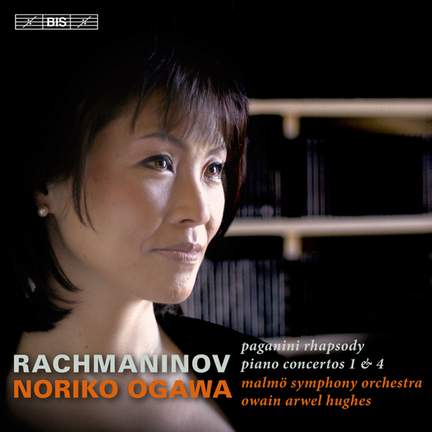
Rachmaninov: Piano Concertos Nos. 1 & 4
Noriko Ogawa (piano)
Malmö Symphony Orchestra, Owain Arwel Hughes
Ogawa never forces the tone. She ensures that beauty, clarity and richness of sound are sustained at all costs, even in the most thunderous passages...Yet to suggest that her playing is cool,...
Rachmaninov: Piano Concertos Nos. 1 & 4
Noriko Ogawa (piano)
Malmö Symphony Orchestra, Owain Arwel Hughes
Purchase product

Ogawa never forces the tone. She ensures that beauty, clarity and richness of sound are sustained at all costs, even in the most thunderous passages...Yet to suggest that her playing is cool,...
About
Noriko Ogawa and the Malmö Symphony Orchestra return to the works of Rachmaninov with a disc featuring his first and fourth piano concertos and Rhapsody on a Theme of Paganini.
Rachmaninov’s first concerto was written while he was a student at the Moscow Concervatory, but underwent considerable revisions up to 1917.
His fourth piano concerto was written after a considerable break from composition as he was kept busy as a touring performer in the USA. The unsuccessful first performance again led to considerable revisions.
The Rhapsody on a Theme of Paginini was his first major composition after the fourth piano concerto and since its première has been an enduring fixture in the repertory.
Noriko Ogawa and the Malmö Symphony have recorded the Second and Third concertos for BIS (BISCD900) which attracted considerable acclaim.
Contents and tracklist
Awards and reviews
 October 2012
Ogawa never forces the tone. She ensures that beauty, clarity and richness of sound are sustained at all costs, even in the most thunderous passages...Yet to suggest that her playing is cool, detached and uninvolving would be utterly misleading...By any standards, this is an outstanding release.
 October 2012
the first movement cadenza, following pages of insouciant athleticism, conveys more vividly than most the image of someone trapped at the bottom of a dark well clawing their way up its side into the sunlight...The Malmo players under Owain Arwel Hughes offer acutely observed support throughout, with the important wind and brass solo writing subtly highlighted to gratifying effect.
