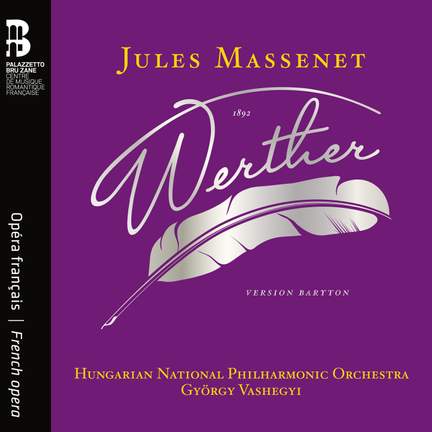
Massenet: Werther
Tassis Christoyannis (Werther), Véronique Gens (Charlotte), Thomas Dolié (Albert), Matthieu Lécroart (Le Bailli), Hélène Carpentier (Sophie)
Hungarian National Philharmonic Orchestra, Children's Choir of the Zoltán Kodály Hungarian Choir School, György Vashegyi

Awards:
-
International Classical Music Awards, 2025, Nominated - Opera

-
Gramophone Awards, 2025 Shortlist, Opera

With his relatively lightweight baritone, Tassis Christoyannis nevertheless proves a sensitive exponent of the lovelorn poet, while Véronique Gens’s Charlotte works well, even if she cannot...
Massenet: Werther
Tassis Christoyannis (Werther), Véronique Gens (Charlotte), Thomas Dolié (Albert), Matthieu Lécroart (Le Bailli), Hélène Carpentier (Sophie)
Hungarian National Philharmonic Orchestra, Children's Choir of the Zoltán Kodály Hungarian Choir School, György Vashegyi
Purchase product

Awards:
-
International Classical Music Awards, 2025, Nominated - Opera
-
Gramophone Awards, 2025 Shortlist, Opera
With his relatively lightweight baritone, Tassis Christoyannis nevertheless proves a sensitive exponent of the lovelorn poet, while Véronique Gens’s Charlotte works well, even if she cannot...
About
Massenet’s Werther is one of those masterpieces that were rejected or shunned at the time of their creation. Sketched in the 1880s, the score was turned down by the director of the Opéra-Comique and had to make do with a premiere in German, far from Paris, before finally being heard in Paris in 1893. It gradually established itself as one of the composer’s most personal works, in which he showed himself to be as fine a colourist as he was a master of the art of the ‘motif de rappel’. In adapting Goethe’s novel, Massenet and his librettists gave greater prominence to the character of Charlotte, thus placing the struggle between duty and passion at the centre of the narrative. The role of Werther, originally assigned to a tenor, was also sung by the baritone Mattia Battistini with the composer’s approval. Provided the singer makes skilful use of voix mixte , this version gives the work a melancholy colouring ideal for portraying its hero’s suicidal temperament. Tassis Christoyannis follows this approach in exemplary fashion, opposite the reserved yet moving Charlotte of Véronique Gens. Both singers give the text the preponderant role allotted to it by French operatic tradition.
Contents and tracklist
- Matthieu Lécroart (soloist), Artavazd Sargsyan (soloist), Laurent Deleuil (soloist), Hélène Carpentier (soloist), Tassis Christoyannis (soloist), Véronique Gens (soloist), Thomas Dolié (soloist)
- Children's Choir of the Zoltán Kodály Hungarian Choir School, Hungarian National Philharmonic Orchestra
- György Vashegyi
- Laurent Deleuil (soloist), Artavazd Sargsyan (soloist), Véronique Gens (soloist), Thomas Dolié (soloist), Tassis Christoyannis (soloist), Hélène Carpentier (soloist)
- Hungarian National Philharmonic Orchestra
- György Vashegyi
- Véronique Gens (soloist), Hélène Carpentier (soloist), Tassis Christoyannis (soloist), Thomas Dolié (soloist)
- Hungarian National Philharmonic Orchestra
- György Vashegyi
- Véronique Gens (soloist), Tassis Christoyannis (soloist), Hélène Carpentier (soloist)
- Hungarian National Philharmonic Orchestra, Children's Choir of the Zoltán Kodály Hungarian Choir School
- György Vashegyi
Spotlight on this release
-
An error occurred.
Try watching this video on www.youtube.com, or enable JavaScript if it is disabled in your browser.
Awards and reviews
-
International Classical Music Awards2025Nominated - Opera
 August 2024
With his relatively lightweight baritone, Tassis Christoyannis nevertheless proves a sensitive exponent of the lovelorn poet, while Véronique Gens’s Charlotte works well, even if she cannot provide sufficient contrast to Hélène Carpentier’s Sophie...The Hungarian National Philharmonic Orchestra is excellent, with conductor György Vashegyi conveying Massenet ’s emotional range and rhythmic flexibility.
 July 2024
It’s an outstanding achievement, in short, that makes the strongest possible case for this particular version, while affording us opportunities to rethink the opera itself. Very highly recommended.