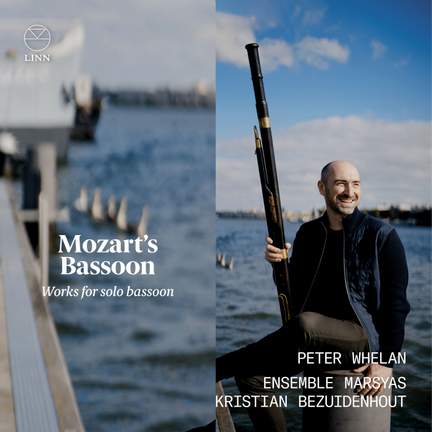
Mozart's Bassoon
Works for Solo Bassoon
Peter Whelan (bassoon), Kristian Bezuidenhout (fortepiano)
Ensemble Marsyas
Awards:
-
Presto Editor's Choice, March 2022

This genial and amiable disc is a joy to listen to.
Mozart's Bassoon
Works for Solo Bassoon
Peter Whelan (bassoon), Kristian Bezuidenhout (fortepiano)
Ensemble Marsyas
Purchase product

Awards:
-
Presto Editor's Choice, March 2022
This genial and amiable disc is a joy to listen to.
About
Returning to his beloved bassoon, Peter Whelan takes a fresh look at the two surviving works by Mozart for the instrument: the Concerto, K191, and Sonata, K292. These attractive early works were most likely composed during the composer’s time in Salzburg. The Concerto is the earliest of his woodwind concertos, and has become a staple work for every bassoon player: it showcases the tremendous capabilities of the pre-nineteenth-century instrument, its agility, extraordinary range and tone colour. Whelan and his virtuoso Ensemble Marsyas are playing from the original printed parts since the autograph score has not survived.
While the Sonata’s original medium is uncertain – for two bass instruments or bassoon and keyboard – Whelan makes it his own with Kristian Bezuidenhout performing the continuo line. Ensemble Marsyas rounds off the programme with Mozart’s most dramatic work for winds, the Serenade in C minor. Composed in Vienna for the Harmonie (the bassoon’s natural home), it served as a musical laboratory where Mozart could experiment with the virtuoso and lyrical possibilities of his Viennese wind soloists who later animated his greatest operas.
Contents and tracklist
Spotlight on this release
-
An error occurred.
Try watching this video on www.youtube.com, or enable JavaScript if it is disabled in your browser.
Awards and reviews
-
Presto Editor's ChoiceMarch 2022
 June 2022
This genial and amiable disc is a joy to listen to.
 March 2022
Whelan brings such genial humour and cantabile beauty to the Bassoon Concerto, and he and Bezuidenhout have a ball with the K292 sonata (where the latter indulges in some deliberately clod-hopping flourishes to witty effect in the finale). The Serenade, too, is beautifully done by the Marsyas winds, with some especially fine horn-playing in the outer movements.