Wagner: Siegfried
Johnny Van Hall (Siegfried), Frieder Aurich (Mime), Tomas Möwes (Der Wanderer), Mario Hoff (Alberich), Hidekazu Tsumaya (Fafner), Catherine Foster (Brünnhilde), Heiki Porsten (Forest Bird), Nadine Weissmann (Erda), Staatskapelle Weimar, Carl St. Clair, Michael Schulz (director)
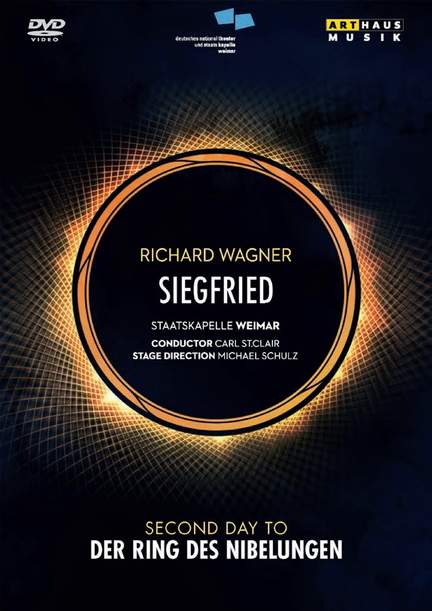
Wagner: Siegfried
Johnny Van Hall (Siegfried), Frieder Aurich (Mime), Tomas Möwes (Der Wanderer), Mario Hoff (Alberich), Hidekazu Tsumaya (Fafner), Catherine Foster (Brünnhilde), Heiki Porsten (Forest Bird), Nadine Weissmann (Erda), Staatskapelle Weimar, Carl St. Clair, Michael Schulz (director)
Purchase product
Other available formats

About
„Carl St.Clair is adept at handling both the apocalyptic mood of the music and the translucent shimmering of the forest. A brilliant achievement.“ Frankfurter Rundschau
„Michael Schulz has staged a Siegfried in which careful attention to detail and grand-scale gestures are perfectly complemented by an abundance of fascinating ideas.“ Opernglas
Richard Wagner’s Ring of the Nibelung refl ects the composer’s autobiography as much as the political turmoil of his times. As work progressed, another fi gure grew to be as important as the hero Siegfried, the god Wotan, the mouthpiece for Wagner’s ideas. “He’s exactly like us: he is the sum of today’s intellectual consciousness, whereas Siegfried is what we hope the human being of the future will be, but who cannot be fashioned by us, and who must make himself by means of our destruction!” Our own doom as the basis of a happier future? Second ‘day’ – and third part – of Richard Wagner’s ‘Ring’, the musical saga that its author spent more than a quarter of a century composing. It follows the rise of a young hero, Siegfried, the illegitimate son of the twins whose story we were told in Die Walküre. On the one hand, there is learning about life, glorying in nature and in the emotions, as opposed to those of calculation and greed on the other. This episode shows how Wagner was intent on changing society, on showing that a different kind of man can exist, that the mercenary petit bourgeois world can be replaced by greater humanity and freedom.
Contents and tracklist
- Johnny Van Hall (tenor), Frieder Aurich (tenor), Tomas Möwes (baritone), Mario Hoff (baritone), Hidekazu Tsumaya (bass), Catherine Foster (soprano), Heiki Porsten (soprano), Nadione Weissmann (mezz-soprano)
- Staatskapelle Weimar
- Carl St Clair
Spotlight on this release
-
Catherine Foster on Wagner
16th Apr 2020
The British dramatic soprano, who sings Brünnhilde on the Weimar Ring Cycle which is now available on Arthaus Musik, talks to Katherine about her remarkable journey from midwifery to Bayreuth.