

Help
Skip to main content

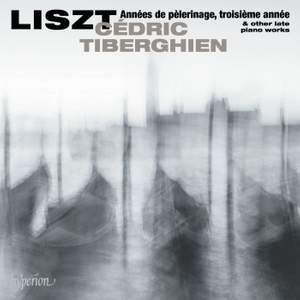
Liszt: Années de pèlerinage, 3ème année

and other late piano works

Cédric Tiberghien (piano)

Liszt: Années de pèlerinage, 3ème année

Awards:

Tiberghien’s quasi-improvisatory approach works marvellously with works which would otherwise risk sounding directionless and self-indulgent. His range is breathtaking, carefully terraced even...

Liszt: Années de pèlerinage, 3ème année

and other late piano works

Cédric Tiberghien (piano)

Purchase product

CD

$17.50

In stock - only 13 left: usually despatched within 1 working day

Download

From$10.00

Download

Audio formats guide

96 kHz, 24 bit, FLAC/ALAC/WAV

$17.50

44.1 kHz, 16 bit, FLAC/ALAC/WAV

$15.00

320 kbps, MP3

$10.00

This release includes a digital booklet

Stream now Hi-RES 96 kHz, 24 bit

Awards:

Tiberghien’s quasi-improvisatory approach works marvellously with works which would otherwise risk sounding directionless and self-indulgent. His range is breathtaking, carefully terraced even...

About

Liszt’s piano works focus on Wagner and western tonality to explore the unsettling meditations on the passing of life, the music of Liszt’s old age is like nothing else of its time. Cédric Tiberghien proves wholly attuned to its unconventional demands in a programme concluding with the third and last of the Années de pèlerinage.

Contents and tracklist

I. Angelus! – Prière aux anges gardiens
Track length8:32
II. Aux cyprès de la Villa d'Este – Thrénodie I
Track length6:06
III. Aux cyprès de la Villa d'Este – Thrénodie II
Track length11:31
IV. Les jeux d'eaux à la Villa d'Este
Track length8:20
V. Sunt lacrymae rerum – en mode hongrois
Track length8:08
VI. Marche funèbre – en mémoire de Maximilien I, Empereur du Mexique, d. 19 juin 1867
Track length7:57
VII. Sursum corda – Erhebet eure Herzen
Track length4:21

Spotlight on this release

Awards and reviews

  • Presto Editor's Choice
    February 2019
  • BBC Music Magazine
    March 2019
    Instrumental Choice

March 2019

Tiberghien’s quasi-improvisatory approach works marvellously with works which would otherwise risk sounding directionless and self-indulgent. His range is breathtaking, carefully terraced even in the thickest of textures, never harsh, abrupt, metronomic or bombastic, even when rumbling in the murkiest depths of the piano’s range.

February 2019

Tiberghien avoids all temptation to overlay these pieces with gratuitous flamboyance, concentrating instead on the finesse and subtle interiority they demand…Generously filled and beautifully recorded, this disc offers a fine entry point for anyone either dipping into late Liszt for the first time or giving it another try.

March 2019

…His playing is of a burning commitment and intensity. This is extraordinary music and few other pianists have captured its pain and disquiet more vividly or eloquently. Hyperion’s sound is superb and even when compared to, say, Lazar Berman’s justifiably celebrated recording, Tiberghien is supreme.

March 2019

A masterful introduction to the strange world of late Liszt.

March 2019

One of the very best discs of these late works now in the catalogue.

February 2019

Many of the qualities which made Tiberghien’s recent account of the Franck Violin Sonata with Alina Ibragimova so special are in evidence in this introspective and often profoundly moving programme of late Liszt, centring on dark nights of the soul: the gentle highlighting of the music’s modernity, the willingness to hold power in reserve until the music positively demands it, and the emphasis on clarity even in the densest thickets of passagework.

31st January 2019

His selection is typically thoughtful...Each is a scaled-down tone poem, which poses its own set of technical challenges. But Tiberghien never flaunts his total command of those challenges and with an exemplary range of touch and keyboard colour, concentrates instead on these pieces purely as musical statements…[He] presents all of them as perfectly conceived miniatures that often pose more questions than they answer.

March 2019

Tiberghien's execution and control are impeccable, and his interpretations are fluid and wholly at the service of Liszt's changeable expressions, whether depicting the diabolical in the Vierter Mephisto-Walzer or the calmly religious in the Angelus of Années de pèlerinage. Along the way, Tiberghien demonstrates mercurial humor in the Bagatelle sans tonalité and sublime tenderness in the Wiegenlied and En rêve, as well as a macabre lyricism in La lugubre gondola II, all while maintaining a consistent understanding of Liszt's work as a whole.
View download progress