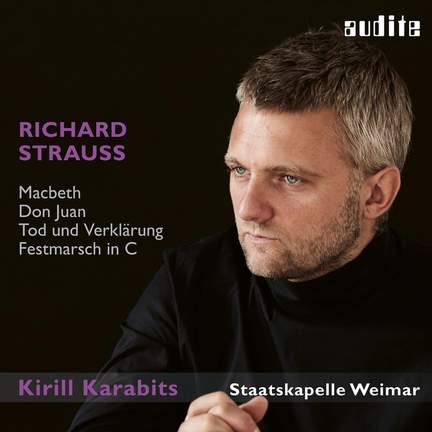
Strauss: Macbeth, Don Juan, Death and Transfiguration & Festmarsch
Staatskapelle Weimar, Kirill Karabits
Karabits and his orchestra take a long time to flame, namely through three-quarters of a far from fiery Don Juan…But when the sparks fly, which they do, fully, for the first time in the sick-bed...
Strauss: Macbeth, Don Juan, Death and Transfiguration & Festmarsch
Staatskapelle Weimar, Kirill Karabits
Purchase product
Karabits and his orchestra take a long time to flame, namely through three-quarters of a far from fiery Don Juan…But when the sparks fly, which they do, fully, for the first time in the sick-bed...
About
Following the release of Prokofiev’s “Cantata for the 20th Anniversary of the October Revolution”, Kirill Karabits dedicates his next audite recording with the Weimar Staatskapelle to the “Weimar” Strauss.
When, in 1889, Strauss assumed his office as Grand Ducal Saxon Kapellmeister, he wrote: “To Weimar, where Liszt worked for so long...”.
Kirill Karabits leads the Staatskapelle Weimar through Strauss’ three early tone poems composed during that time. Strauss himself described these works as “a completely new path”. The contemporaneous Festmarsch is a true rarity.
Weimar was not only the metropolis of the classical era that acquired world fame thanks to Goethe and Schiller. Weimar was also the domain of great musicians: Franz Liszt served as Kapellmeister in the city and invented the genre of the symphonic poem. Richard Strauss followed in his footsteps when he, as Kapellmeister from 1889 until 1894, presented his own first symphonic poems, “Macbeth” and “Don Juan”, at the helm of the Weimar court orchestra. Kirill Karabits, Generalmusikdirektor of the Deutsches Nationaltheater since 2016, now presents, alongside today’s Weimar Staatskapelle, not only these two major works of his great predecessor, but also “Tod und Verklärung” (Death and Transfiguration), which Strauss had completed in Weimar. The contemporaneous Festmarsch in C major, TrV157 – Strauss’ anniversary gift to “Die Wilde Gung’l”, the Munich orchestra he had conducted in his youth – is a true rarity, rounding off this recording.
Contents and tracklist
Awards and reviews
 August 2018
Karabits and his orchestra take a long time to flame, namely through three-quarters of a far from fiery Don Juan…But when the sparks fly, which they do, fully, for the first time in the sick-bed agonies of the dying man, there’s one performance here to set up there with the best.