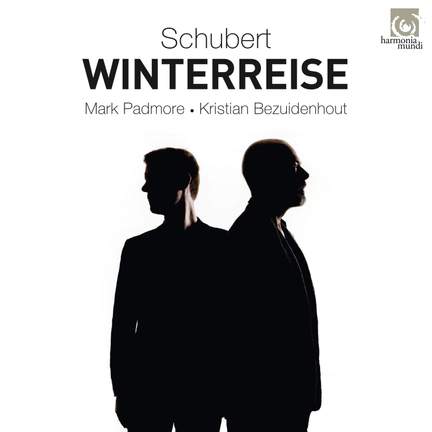
Special offer. Schubert: Winterreise D911
Mark Padmore (tenor), Kristian Bezuidenhout (fortepiano)
[Padmore’s] fairly reedy tone and his restraint in matters of volume go well with the instrument, and Kristian Bezuidenhout is a sympathetic accompanist…Padmore’s interpretation, too, I would...
Special offer. Schubert: Winterreise D911
Mark Padmore (tenor), Kristian Bezuidenhout (fortepiano)
Purchase product

[Padmore’s] fairly reedy tone and his restraint in matters of volume go well with the instrument, and Kristian Bezuidenhout is a sympathetic accompanist…Padmore’s interpretation, too, I would...
About
A journey into the Romantic self. It is clear from its genesis that Schubert did not have any strict dramatic action in mind in this song cycle. Unlike Die schöne Müllerin, Winterreise tells no story; it is a journey into the interior, into ever-deeper realms of loneliness. As Peter Gülke has put it: ‘The only progress the wanderer makes is a progress in perception, the agonising discharge of his memories, constantly threatened by regressions. . . . Continually in search of confirmations of his condition, he observes with an all too alert, painfully keen sensibility, and like an egocentric melancholic refers everything to himself or selects objects so that they can serve as mirror images and corroborations.’ To that extent, the sequence of the songs is not of decisive importance, since 'each of the melancholies he experiences is the worst at the time' (Gülke again).
The testimony of his friends justifies us in relating this ‘psychological profile of a melancholic character’ to Schubert himself. Nikolaus Harnoncourt once described the boundlessly subjective as the decisive factor in Schubert’s music. In Winterreise, the composer allowed his friends to look more deeply into his heart than ever before, which of course tended to repel sanguine characters like Schober. The ironic refraction and distance of the typical Viennese is here sublated (aufgehoben, in the Hegelian sense). Schubert’s friend Johann Mayrhofer immediately recognised this. For him, the cycle was a symptom of ‘how much more serious the composer became. He had been long and seriously ill, he had gone through disheartening experiences, and life had been stripped of its rosy colour; winter had come for him. The poet’s irony, rooted in despair, had appealed to him; he expressed it in cutting tones.’ The winter and the journey of the title are therefore, in the sense of Romantic irony, to be understood as the winter of life and a journey deeper and deeper into unhappiness, experienced by none other than the composer himself. Hence his feelings are isolated from his environment; they do not expect understanding on the part of his friends. The world of the melancholic is self-centred and hermetic.
Contents and tracklist
Awards and reviews
 April 2018
[Padmore’s] fairly reedy tone and his restraint in matters of volume go well with the instrument, and Kristian Bezuidenhout is a sympathetic accompanist…Padmore’s interpretation, too, I would say, is intense and perhaps unusually inward, very much a journey of the tormented soul rather than one through a bleak and unaccommodating landscape.
 March 2018
There’s a wealth of interest to be found at the keyboard…I love the hazy twang Bezuidenhout produces at the start of ‘Der Lindenbaum’…in the later stages of the cycle, in particular, the tenor offers singing of remarkable patience, control and concentration…One notices, however, that the voice has lost some juice.
 4th February 2018
[Bezuidenhout] opts for the transparent, silvery colours of a restored Graf fortepiano, wonderfully ghostly when he applies soft pedal. Padmore’s control of colour and phrase remains astonishing, and he explores yet more affectingly and powerfully the lonely soul of everyman.
 25th January 2018
There’s no doubt the expressiveness Bezuidenhout obtains from the light-toned instrument matches Padmore’s lyrical, delicate approach very well.
Record Review 20th January 2018
Bezuidenhout playing a Graf piano whose colours, timbres and characteristic attack and decay change so much about the way we experience this bleak journey through a winter landscape. Padmore’s interpretation has shifted to match it, I found it darker, less overtly beautiful, even more expressive than his 2009 recording with Paul Lewis and that is a fine performance.