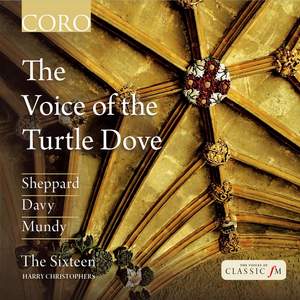


Offer,The Voice of the Turtle Dove
The Sixteen, Harry Christophers
The artistry of The Sixteen makes this disc worthwhile. More satisfying, however, would be if the group would re-engage with under- or never-recorded Tudor masterpieces, rather than with its... — More…
CD
Original price ($15.00) Reduced price $12.00Downloads
What are FLAC and MP3?Contents
Sheppard, J: Gaude gaude gaude Maria
Work length14:10
$2.00
$2.80
- The Sixteen
- Harry Christophers
Mundy, W: Adolescentulus sum ego
Work length5:37
$1.00
$1.40
- The Sixteen
- Harry Christophers
Davy, R: O Domine caeli terraeque creator
Work length14:43
$2.00
$2.80
- The Sixteen
- Harry Christophers
Sheppard, J: Libera nos 1 & 2
Work length6:30
$1.00
$1.40
- The Sixteen
- Harry Christophers
Sheppard, J: In manus tuas I
Work length3:48
$1.00
$1.40
- The Sixteen
- Harry Christophers
Davy, R: Ah, mine heart, remember thee well
Work length4:59
$1.00
$1.40
- The Sixteen
- Harry Christophers
Sheppard, J: In manus tuas III
Work length3:42
$1.00
$1.40
- The Sixteen
- Harry Christophers
Mundy, W: Vox Patris caelestis
Work length17:37
Album only
Album only
- The Sixteen
- Harry Christophers