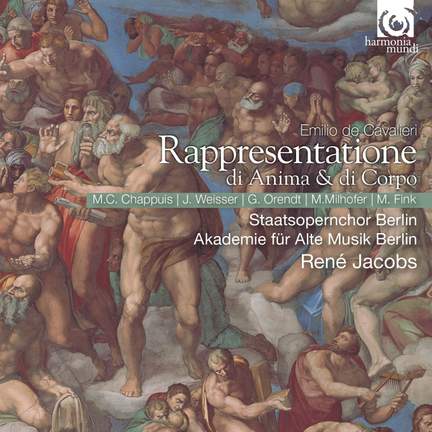
Special offer. Cavalieri: Rappresentazione di Anima e di Corpo
Marie-Claude Chappuis (Anima), Johannes Weisser (Corpo), Gyula Orendt (Tempo, Consiglio), Mark Milhofer (Inteletto, Piacere), Marcos Fink (Mondo, Secondo Compagno di Piacere, Anima dannata)
Staatsopernchor, Concerto vocale, Akademie für Alte Musik Berlin, René Jacobs
this is an extravagant and embellished view of the original score, at times almost Romantic with its opulent orchestral palette and lush choral singing...Jacobs and his superb musicians produce...
Special offer. Cavalieri: Rappresentazione di Anima e di Corpo
Marie-Claude Chappuis (Anima), Johannes Weisser (Corpo), Gyula Orendt (Tempo, Consiglio), Mark Milhofer (Inteletto, Piacere), Marcos Fink (Mondo, Secondo Compagno di Piacere, Anima dannata)
Staatsopernchor, Concerto vocale, Akademie für Alte Musik Berlin, René Jacobs
Purchase product

this is an extravagant and embellished view of the original score, at times almost Romantic with its opulent orchestral palette and lush choral singing...Jacobs and his superb musicians produce...
About
Composed at a time when neither oratorio nor opera existed, this 'Rappresentatione' premiered in February 1600 is a magisterial musical drama. In its dialogue between Soul and Body, an emblematic theme of the Counter-Reformation, employing singers, chorus, and an extensive orchestra whose varied timbres both accompany and characterise the soloists. At the dawn of the Baroque revolution, song, stage action, dance, and instrumental music combine in perfect harmony. Since the 'Rappresentatione' is fully staged, in three acts with a spoken prologue, it can be considered to be the first surviving opera as such.
Emilio de‘ Cavalieri already had an eventful artistic life behind him when he gave the 'Rappresentatione' in February 1600 at the Oratorio della Vallicella in Rome. He was born around 1550 into a wealthy aristocratic Roman family, the son of Tommaso de‘ Cavalieri, Michelangelo’s closest friend and who had easy access to the Vatican as an adviser in artistic matters. It is there that Emilio must have got to know Ferdinando de‘ Medici, the sixth son of the Grand Duke of Tuscany. When Ferdinando, after the death of his older brothers, doffed the cardinal’s purple to become Grand Duke of Tuscany, he took Cavalieri with him to Florence and appointed him intendant of court festivities. Cavalieri was responsible for the famous musical intermedi to 'La Pellegrina' of 1589, staged for the Grand Duke’s marriage, regarded as the most important forerunner of opera.
In subsequent years he maintained close diplomatic relations with the papal court on behalf of the Grand Duke and commuted regularly back and forth between Florence and Rome. Hence he came to assist Pope Clement VIII in the artistic organisation of the Holy Year 1600. It was on this occasion that he presented a work for which he claimed to have invented ‘recitar cantando’ – sung dramatic declamation – a few months before the first operas were produced in Florence in October 1600, during celebrations accompanying the wedding of Maria de‘ Medici with the King of France. Cavalieri himself scarcely had an opportunity to contribute to the further development of musical drama. Almost exactly two years after the performance of the Rappresentatione, he died in his native city. A memorial tablet in S. Maria in Aracoeli still reminds visitors today that he lies buried in this church on the Capitol.
Booklet includes ‘Let every thing that hath breath . . .’ notes on the work and on performance practice by René Jacobs and full libretto.
Contents and tracklist
- Akademie für Alte Musik Berlin, René Jacobs, Chor der Deutschen Staatsoper Berlin, Serena Malcangi, Loredana Gintoli
- Chor der Deutschen Staatsoper Berlin, Akademie für Alte Musik Berlin, René Jacobs
- Mark Milhofer, Akademie für Alte Musik Berlin, René Jacobs
- Chor der Deutschen Staatsoper Berlin, Akademie für Alte Musik Berlin, René Jacobs
- Chor der Deutschen Staatsoper Berlin, Akademie für Alte Musik Berlin, René Jacobs
- Chor der Deutschen Staatsoper Berlin, Akademie für Alte Musik Berlin, René Jacobs
- Mark Milhofer, Kyungho Kim, Marcos Fink, Johannes Weisser, Marie-Claude Chappuis, Akademie für Alte Musik Berlin, René Jacobs
- Christina Roterberg, Chor der Deutschen Staatsoper Berlin, Akademie für Alte Musik Berlin, René Jacobs
- Marcos Fink, Johannes Weisser, Marie-Claude Chappuis, Christina Roterberg, Luciana Mancini, Chor der Deutschen Staatsoper Berlin, Akademie für Alte Musik Berlin, René Jacobs
- Christina Roterberg, Elisabeth Fleming, Benno Schachtner, Florian Feth, Hugo Oliveira, Akademie für Alte Musik Berlin, René Jacobs
Awards and reviews
 Awards Issue 2015
this is an extravagant and embellished view of the original score, at times almost Romantic with its opulent orchestral palette and lush choral singing...Jacobs and his superb musicians produce sumptuous colours and textures...Acoustical effects, echoes, off-stage voices and instruments dramatise the earthly and the intangible divine.
CD Review 28th March 2015
hugely enjoyable and entertaining...it’s beautiful, it’s a big, lavish production.
 May 2015
[Jacobs's] reading, derived from a staging at Berlin's Staatsoper im Schiller-Theater, absolutely reeks of the stage...firmly characterised singing and lusty playing. Rappresentatione may not be a masterpiece of opera but surely no performance has ever worked harder on its behalf than this one.
 19th February 2015
Typically Jacobs make the orchestral realisation of the score sumptuous within its turn-of-the-17th-century constraints; no one could mistake this for anything but a grandly ceremonial piece.