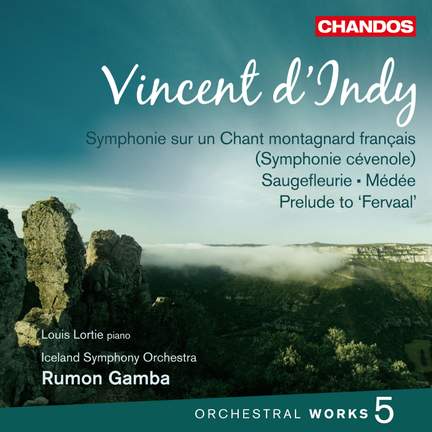
Special offer. Vincent d’Indy - Orchestral Works Volume 5
Louis Lortie (piano)
Iceland Symphony Orchestra, Rumon Gamba
For me, the palm goes to the delightful and generally ignored Saugefleurie, where duty bows before inspiration. Throughout, the playing is warm and unfussy.
Special offer. Vincent d’Indy - Orchestral Works Volume 5
Louis Lortie (piano)
Iceland Symphony Orchestra, Rumon Gamba
Purchase product

For me, the palm goes to the delightful and generally ignored Saugefleurie, where duty bows before inspiration. Throughout, the playing is warm and unfussy.
About
This is Volume 5 in our series dedicated to the orchestral works of Vincent d’Indy, nicknamed ‘The Samson of Music’ by Fauré, for his work as a composer, conductor, and teacher. His style was essentially eclectic, strongly influenced by Beethoven and Wagner, into which he frequently incorporated folk melodies.
Based on a folk tune from the Tourtous, the Symphonie sur un chant montagnard français is today one of the best-loved works by d’Indy. This highly atmospheric work is scored for piano and orchestra; however, far from engaging in conflict with the orchestra, the soloist here operates on equal terms. The solo part is performed by the internationally acclaimed pianist Louis Lortie.
The symphonic poem Saugefleurie tells the story of the tragic love between Saugefleurie, a lonely yet charming little fairy, and the King’s son, based on a poem from the Contes de fees by Robert de Bonnières, a friend of the composer’s. The Wagnerian influence is apparent throughout; however, in terms of orchestration and sonority this work remains characteristically French.
Among the now forgotten works of the French poet, novelist, and dramatist Catulle Mendès is the play Medée, based on the Greek myth of Medea, who murdered her two sons in revenge for her rejection by her lover Jason, the leader of the Argonauts. D’Indy wrote incidental music to the play in 1898, and later preserved it in the form of an orchestral suite in five movements, recorded here.
Also on the theme of doomed love is d’Indy’s first opera, Fervaal, a work of Wagnerian scale and proportions, and clearly displaying the influence of Parsifal in the complex network of leitmotivs. At the same time, in its historical setting at the time of the Saracen invasion, and in its musical evocation of local colour, it reflects the earlier Parisian Grand Opéra of Meyerbeer and Halévy.
This recording is the first ever made at Harpa, the new concert hall in Reykjavik, which opened its doors to the public in May 2011, and was subsequently named by Gramophone one of the greatest concert halls of the new millennium.
Contents and tracklist
- Rumon Gamba, Iceland Symphony Orchestra, Louis Lortie
- Recorded: 29 October - 1 November 2012
- Recording Venue: Eldborg, Harpa, Reykjavik, Iceland
- Rumon Gamba, Iceland Symphony Orchestra
- Recorded: 29 November - 1 December 2011
- Recording Venue: Eldborg, Harpa, Reykjavik, Iceland
- Rumon Gamba, Iceland Symphony Orchestra
- Recorded: 29 October - 1 November 2012
- Recording Venue: Eldborg, Harpa, Reykjavik, Iceland
- Rumon Gamba, Iceland Symphony Orchestra
- Recorded: 29 November - 1 December 2011
- Recording Venue: Eldborg, Harpa, Reykjavik, Iceland
Awards and reviews
 August 2013
For me, the palm goes to the delightful and generally ignored Saugefleurie, where duty bows before inspiration. Throughout, the playing is warm and unfussy.
 June 2013
d'Indy is his own man, conjuring up fragrant atmosphere from his mountain theme and generating a good deal of healthy vigour in the finale. All this is potently communicated by the orchestral playing and by Louis Lortie's scintillating fluency in the piano obbligato.
 May 2013
Lortie is so sensitively attuned to a piano part whose sheer dexterity is partly offset only by its frequent self-effacement...Gamba yields very little to Andre Cluytens in terms of his identity with a work that is well deserving of revival.
 11th April 2013
the mixture of post-Wagnerian chromaticism and refined orchestral sensuousness is typical of a style that left an indelible impression on French music for decades. The performances, from the Iceland Symphony under Rumon Gamba, are faultless. Louis Lortie is the restrained yet dexterous soloist in the Symphonie.