Mozart & M Haydn: Duo Sonatas
Rachel Podger (violin) & Jane Rogers (viola)
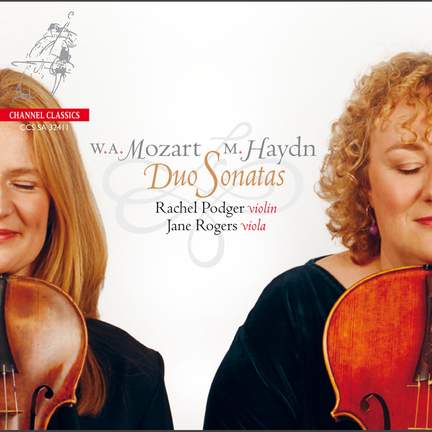
So well matched are Rachel Podger and Jane Rogers that they sound musically inseparable. Remarkably fresh and spontaneous-sounding performances, meticulously voiced and balanced, that are models...
Mozart & M Haydn: Duo Sonatas
Rachel Podger (violin) & Jane Rogers (viola)
Purchase product

So well matched are Rachel Podger and Jane Rogers that they sound musically inseparable. Remarkably fresh and spontaneous-sounding performances, meticulously voiced and balanced, that are models...
About
The Duos for Violin and Viola by Mozart have long been favourite pieces of ours – pieces we'd take out and play when there wasn't a keyboard player or cellist to hand, or busk as teenagers to earn extra pocket money. Back then, the audience's response clearly indicated how appealing these pieces were as our takings always doubled when we played them! These works never cease to amaze – Mozart uses the two instruments so effectively and with such exquisite craftsmanship that he never leaves one wondering where the rest of the string quartet might have gone….They are also hugely engaging to play and so endlessly rich and interesting that the appeal to the listener is guaranteed.
Mozart's reference to other genres is always fascinating. In this case the writing is dramatic, operatic even (the violin taking the role as soprano diva (!) and the viola as the heroic tenor?!). One could perhaps go as far to say that these duos are distillations of the art of chamber music as in the Haydn quartets, but more naturally recreational and less self-conscious. For a violist they are about as exposed as you can be; hitherto very few sonatas or con certi had been written for solo viola - and the accompaniment would seldom have been as scant as a single violin. The conversational and imitative nature of the writing allows for freedom and characterization, and it was refreshing and rewarding to be as spon taneous as possible in the recording sessions.
It was also a diverting and enjoyable experience to record two of the Michael Haydn duos, previously unknown to us both. The character of these pieces is often reminiscent of Austrian folk music and it really seems as if you can hear the yodelling vernacular bouncing off the mountains in timely echoes. The challenges in these works are quite different to those of his friend Wolfgang – the demands placed on the violinist are obvious as the writing is busy, yet in need of a casual fluidity, whereas the violist has the task of being constantly inventive with material which is largely accompanimental (melody and bass, in effect). Who knows? Maybe Wolfgang and Michael tried these out during Mozart's visit to Salzburg when he helped his friend complete a set of six Sonatas in 1783.
Contents and tracklist
- Rachel Podger (violin), Jane Rogers (viola)
- Rachel Podger (violin), Jane Rogers (viola)
- Rachel Podger (violin), Jane Rogers (viola)
- Rachel Podger (violin), Jane Rogers (viola)
- Rachel Podger (violin), Jane Rogers (viola)
Awards and reviews
 March 2012
So well matched are Rachel Podger and Jane Rogers that they sound musically inseparable. Remarkably fresh and spontaneous-sounding performances, meticulously voiced and balanced, that are models of Classical poise and precision.
 January 2012
No virtuoso excitement, but a virtuoso ease to the rhythmic elasticity of the playing; and the sinuous lines, the subtle variations within sonorities, the enuciation of inflections and nuances that cannot be written, all amount to an artist's right to interpretation. Podger and Rogers use theirs, adding tonal gradations to long sections of K424 that Mozart left bare. They do him proud.
 January 2012
Their use of gut strings makes for a different timbre, slightly more throaty than with the more up to date versions, though there is no lack of sparkle and upper resonance in the sonorities produced. These musicians don’t go overboard seeking dramatic effect or extra expressive emphasis, playing within the character of their instruments and bringing the music to life very effectively indeed.
 15th January 2012
Wisely, Podger and Rogers have recorded only two of Haydn’s four agreeable contributions to the set: they pale besides the Mozart duos, which, in these lush-sounding performances, seem like studies for the great set of quartets dedicated to Michael’s older sibling.