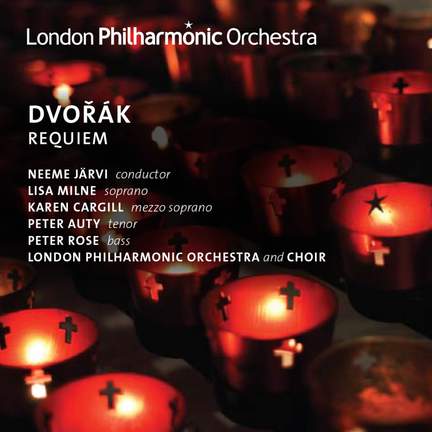
Dvořák: Requiem, Op. 89
Lisa Milne (soprano), Karen Cargill (mezzo soprano), Peter Auty (tenor) & Peter Rose (bass)
London Philharmonic Orchestra and Choir, Neeme Järvi
Awards:
-
Gramophone Magazine, January 2010, Editor's Choice

All the virtues of Järvi's approach come together… in the Agnus Dei: beautifully paced and crafted, the performance captures superbly the radiance of Dvorák's vision of the hereafter.
Dvořák: Requiem, Op. 89
Lisa Milne (soprano), Karen Cargill (mezzo soprano), Peter Auty (tenor) & Peter Rose (bass)
London Philharmonic Orchestra and Choir, Neeme Järvi
Purchase product
Awards:
-
Gramophone Magazine, January 2010, Editor's Choice
All the virtues of Järvi's approach come together… in the Agnus Dei: beautifully paced and crafted, the performance captures superbly the radiance of Dvorák's vision of the hereafter.
About
Rarely heard in concert at all, the Requiem by Antonín Dvorák captured on this CD from a live concert seems a near-forgotten masterpiece. Dvorák scholar Gervase Hughes cites this work for four soloists, chorus and orchestra as one of the composer’s finest sacred creations, ‘a deeply moving expression of faith on the part of a composer whose religious conviction never wavered’. It’s a conviction stamped through the composer’s illuminating, fervent score.
Contents and tracklist
- Neeme Järvi, London Philharmonic Orchestra, Lisa Milne, Karen Cargill, Peter Auty (tenor), Peter Rose, London Philharmonic Choir, Neville Creed
Awards and reviews
-
Gramophone MagazineJanuary 2010Editor's Choice
 Christmas 2009
All the virtues of Järvi's approach come together… in the Agnus Dei: beautifully paced and crafted, the performance captures superbly the radiance of Dvorák's vision of the hereafter.
 January 2010
…this is essentially an ensemble work, and one of Järvi's strengths lies in allowing the choir to sing with an almost improvisatory fluency, though it is of course the product of a deep understanding and watchful control of Dvorák's melodic lines. Järvi makes his points without labouring them. The heavy rhythms of the "Dies irae" are far more telling than over-emphatic thumping; the touch of harshness at the opening of the "Tuba mirum" exactly reflects the intention of the music; in the "Pie Jesu" there is grace and gentleness that never lapses towards sentimentality.