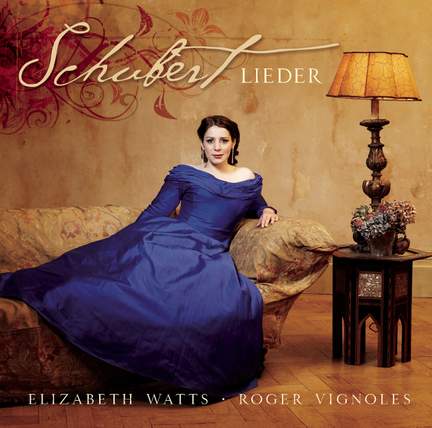
Schubert - Lieder
Elizabeth Watts (soprano) & Roger Vignoles (piano)
Awards:
-
Gramophone Magazine, February 2009, Editor's Choice

…Watt's youthful, radiant delivery, with no flaws in technique that I can hear, fits many of the Lieder like a glove.
Schubert - Lieder
Elizabeth Watts (soprano) & Roger Vignoles (piano)
Purchase product

We pay more royalties to artists and composers than any other streaming service with our innovative Fair Play pay-per-second model
We pay artists and composers fairly with our pay-per-second model
Awards:
-
Gramophone Magazine, February 2009, Editor's Choice
…Watt's youthful, radiant delivery, with no flaws in technique that I can hear, fits many of the Lieder like a glove.
About
SONY BMG Masterworks is delighted to present the debut solo album by soprano Elizabeth Watts. Born in 1979, Elizabeth has already garnered an impressive list of accolades, including reaching the final and winning the prestigious Rosenblatt Recital Song Prize at the 2007 Cardiff Singer of the World Competition, winning the Kathleen Ferrier Prize in 2006, the MIDEM Classique Award for Outstanding Young Artist Award in 2007, and has also been selected for BBC Radio 3’s New Generation Artists Scheme.
Contents and tracklist
Awards and reviews
-
Gramophone MagazineFebruary 2009Editor's Choice
 January 2009
…Watt's youthful, radiant delivery, with no flaws in technique that I can hear, fits many of the Lieder like a glove.
 2010
2010
Hailed as a singer to watch after winning the 2006 Kathleen Ferrier Award and the 2007 Cardiff Song Prize, Elizabeth Watts makes her CD debut with this refreshingly unhackneyed Schubert programme. Perennial soprano favourites – DieForelle, Nacht und Träume, Frühlingsglaube, Suleika – are not shunned. But Watts has alighted on some rarely aired gems. How often in recital do we hear the agitated scena-in-miniature AusDiego Manzanares; or the playfully charming paean to spring Die Blumensprache; or the Novalis setting Marie, where sacred and profane blur in a song of exquisite, rarefied grace? A voice in its first, radiant freshness is always to be cherished in Schubert. Watts is a thoughtful interpreter, too, alive to mood and atmosphere, colouring her tone in response to a darkening of the harmony in, say, Sei mir gegrüsst. Crucially, she also brings a measure of innocence and simplicity – not quite the same thing as artlessness – to many of these songs, allied to a technical mastery that allows her to spin a rapt, unblemished line in Nacht und Träume. Encouraged by Vignoles's buoyant accompaniment, she makes an engaging story-teller in Die Forelle, with an unexaggerated touch of indignation at the angler's treachery; and she sings the mildly salacious refrain song Die Männer sind méchant with just the right wide-eyed mock-pathos.
Quibbles? Well, in one or two songs, including the opening An den Mond, Watts struck me as overly languid. She treats Nähe des Geliebten as an elegiac litany, where, say, Janet Baker, choosing a more mobile tempo and finding greater variety from verse to verse, sings it as a passionate avowal of love. Watts also emphasises melancholy over excited anticipation in Frühlingsglaube and Suleika. Here and elsewhere, Watts under-exploits the expressive potential of German consonants. That said, highlights are lovely performances of Nachtviolen – the high tessitura effortlessly negotiated – or the Mozartian barcarolle Liane: just two songs among many where the vernal purity of Watts's tone and the grace of her phrasing are priceless assets.
 February 2009
A voice in its first, radiant freshness is always to be cherished in Schubert. Watts is a thoughtful interpreter, too, alive to mood and atmosphere… Crucially, she also brings a measure of innocence and simplicity - not quite the same thing as artlessness - to many of these songs, allied to a technical mastery that allows her to spin a rapt, unblemished line in "Nacht und Träume".