Estampies & Danses Royales - The King's Manuscript
Hespèrion XXI, Jordi Savall
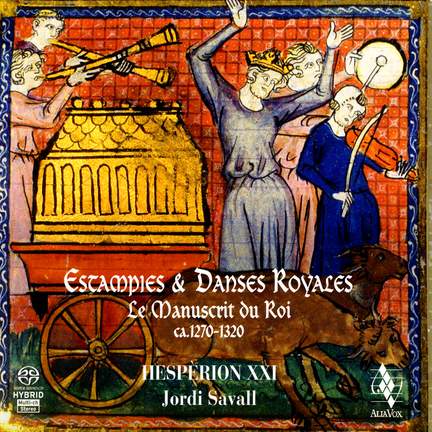
Brilliantly engineered, the contrasts of colours, play with textures and mix of timbres infuse the disc with vitality.
Estampies & Danses Royales - The King's Manuscript
Hespèrion XXI, Jordi Savall
Purchase product

Brilliantly engineered, the contrasts of colours, play with textures and mix of timbres infuse the disc with vitality.
About
Vigorous and colourful medieval dances revealed by Jordi Savall! The Estampie is a medieval dance consisting of four to seven sections, called puncta, each of which is repeated (in the form aa, bb, cc, etc...).The more widely accepted etymology relates it to stamper, to stamp the feet.
Illuminations and paintings from the period seem to indicate that the estampie involves fairly vigorous hopping. The earliest reported example of this musical form is the song "Kalenda Maya" (track 3), supposedly written by the troubadour Raimbaut de Vaqueiras (1180-1207) to the melody of an estampida played by French jongleurs. In this irresistible album, Jordi Savall explores a Royal manuscript from the French National Library.
Contents and tracklist
Awards and reviews
 May 2008
Brilliantly engineered, the contrasts of colours, play with textures and mix of timbres infuse the disc with vitality.
 June 2008
Authentic' requires a pinch of salt but Savall captures the spirit wonderfully.
 6th June 2008
Savall and Hesperion XXI have made their own decisions about the details of instrumentation and rhythmic shapes that are not indicated in the originals, and introduce melodic embellishments and passages of improvisation where it seems appropriate. The engaging results evoke a very distant musical world without too much self-conscious posturing or tendentious theorising.
 14th June 2008
Each piece is given its own distinctive flavour with a scoring chosen from Hespèrion XXI's intriguing palette of instrumental colours, which include not only bowed and plucked strings, flutes and a panoply of percussion, but also dulcimer, hurdy-gurdy and a piquant pair of oboe-like chalemies.
Toe-tappingly compulsive rhythmic energy and exuberance, combined with improvisatory spontaneity, give the performances an appealing air of timelessness
 16th May 2008
Savall’s interpretations of the bare melodies are studious, restrained, but never dry and they create much haunting magic. Originally this was dance music for the medieval rich and famous, but we can all join in now.