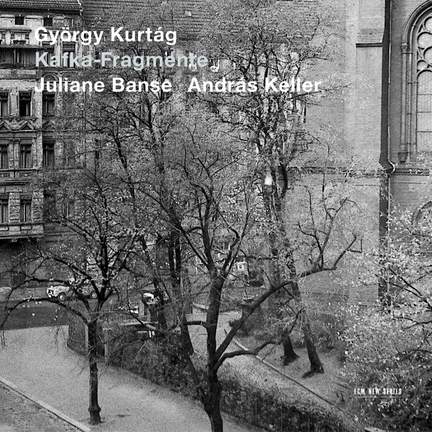
Special offer. Kurtág: Kafka-Fragments Op. 24
Juliane Banse (soprano), Andras Keller (violin)
…Kurtág's Kafka-Fragmente of 1985-86 seems the archetypal late 20th-century song-cycle. The musical language, reduced to shards and splinters, has roots from Bach to Webern, via Schumann…...
Special offer. Kurtág: Kafka-Fragments Op. 24
Juliane Banse (soprano), Andras Keller (violin)
Purchase product

We pay more royalties to artists and composers than any other streaming service with our innovative Fair Play pay-per-second model
We pay artists and composers fairly with our pay-per-second model
…Kurtág's Kafka-Fragmente of 1985-86 seems the archetypal late 20th-century song-cycle. The musical language, reduced to shards and splinters, has roots from Bach to Webern, via Schumann…...
About
Contents and tracklist
- Juliane Banse (soprano), András Keller (violin)
- Recorded: 2005-09-21
- Recording Venue: Historischer Reitstadel in Neumarkt In der Oberpfalz
- Juliane Banse (soprano), András Keller (violin)
- Recorded: 2005-09-21
- Recording Venue: Historischer Reitstadel in Neumarkt In der Oberpfalz
- Juliane Banse (soprano), András Keller (violin)
- Recorded: 2005-09-21
- Recording Venue: Historischer Reitstadel in Neumarkt In der Oberpfalz
- Juliane Banse (soprano), András Keller (violin)
- Recorded: 2005-09-21
- Recording Venue: Historischer Reitstadel in Neumarkt In der Oberpfalz
Awards and reviews
 April 2006
…Kurtág's Kafka-Fragmente of 1985-86 seems the archetypal late 20th-century song-cycle. The musical language, reduced to shards and splinters, has roots from Bach to Webern, via Schumann… Juliane Banse is focussed in the drama and atmosphere of each phrase over the cruelly immense vocal range... András Keller has long been associated with Kurtág's music... plays with sovereign eloquence. Urgently recommended.
 2010
2010
Over nearly 50 years, György Kurtág has composed several major song-cycles – Kafka Fragments being the biggest in size and scope. Written over an intensive spell in 1985-86, the selection and editing of texts had actually been taking place since Kurtág came across Kafka's writings during his studies in Paris three decades earlier, and this release of creative energy permeates the music to a degree typical of this most inscrutable yet fiercely communicative of composers.
The combination of voice and violin should not be taken to imply emotional restraint, any more than the brevity of the texts imposes arbitrariness on the formal trajectory of this hourlong cycle. The 19 fragments of Part 1 present facets of a skewed but all-encompassing 'worldview' – set in relief by the lengthy single setting of Part 2, 'The true path', that is the becalmed centre of Kafka's (hence Kurtág's) expressive universe. The 12 numbers that comprise Part 3 build in intensity to the authentically Kafkaesque vision of 'Scene on a tram', with its sense of the surreal in the everyday, then Part 4 reconfigures previous gestures in a further eight numbers, culminating in 'The moonlit night dazzled us…', with its aura of bleak transcendence.
In its vast extremes of elation and despair, Kafka Fragments is both unnerving and inspiring.
Juliane Banse is fully at ease with its myriad emotional shades and techniques of realising them. András Keller offers playing of real insight. Recorded with spacious immediacy and extensively annotated, this is a fitting commemoration of Kurtág's 80th birthday: no one thus encountering his music for the first time will be left unmoved.
 June 2006
In its vast extremes of elation and despair, Kafka Fragments is both unnerving and inspiring. Juliane Banse is fully at ease with its myriad emotional shades and techniques of realising them - less mercurial than Adrienne Csengery and less intimate than Anu Komsi, but no less acute in her response. Recorded with spacious immediacy and extensively annotated, this is a fitting commemoration of Kurtág's 80th birthday: no one thus encountering his music for the first time will be left unmoved.