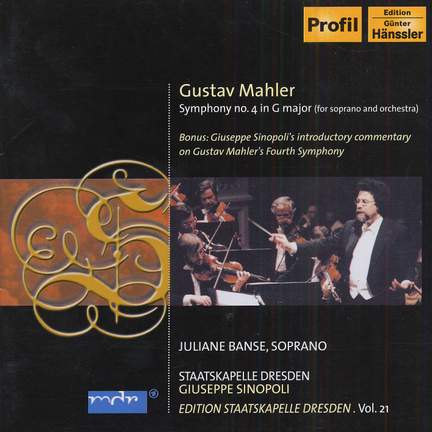
Edition Staatskapelle Dresden - Volume 21
Juliane Banse (soprano)
Staatskapelle Dresden, Giuseppe Sinopoli
Awards:
-
Gramophone Magazine, August 2008, Editor's Choice

'Glorious' and 'sublime' were among the epithets applied to the playing of Dresden's 'Royal Chapel' ensemble when Mahler's Fourth Symphony was first performed in the city in 1908. Both epithets...
Edition Staatskapelle Dresden - Volume 21
Juliane Banse (soprano)
Staatskapelle Dresden, Giuseppe Sinopoli
Purchase product

We pay more royalties to artists and composers than any other streaming service with our innovative Fair Play pay-per-second model
We pay artists and composers fairly with our pay-per-second model
Awards:
-
Gramophone Magazine, August 2008, Editor's Choice
'Glorious' and 'sublime' were among the epithets applied to the playing of Dresden's 'Royal Chapel' ensemble when Mahler's Fourth Symphony was first performed in the city in 1908. Both epithets...
About
Contents and tracklist
III. Ruhevoll, poco adagio
Track length21:58
This track is only available as an album download.
Mahler:
Eine Einfuhrung von Giuseppe Sinopoli in Gustav Mahlers 4. Sinfonie (Ausschnitte) [Giuseppe Sinopoli's intorductory commentary on Gustav Mahler's Fourth Symphony]
Work length17:10
So wollte ich Sie, [...] mit den Anfang der Sinfonie gruben. [I though I would greet you, [...] with the opening bars of the symphony.]
Track length4:07
Ich mochte lhnen nun den Anfang dieses Liedes vorspielen. [I should now like to play the beginning of This song]
Track length1:48
Der erste Satz, [...] ist in Sonatenform Komponiertnen. [the first movement [...] Is in sonata form.]
Track length2:04
Und anschliebend ensteht das zweite Thema des Hauptsatzes: [and then comes the second theme of the first part of the expositon:]
Track length0:25
Und jetzt kommt, was oft in der klassischen Musik geschieht... [Now comes something which often happens in Classical music...]
Track length1:36
Und jetzt horen Sie den Seitensatz. [and now you hear the second part of the exposition.]
Track length1:15
Beethovens Klaviersonate op. 27 Nr.1 enthait imersten Satz ein thema, das absolut [...] [the first movemetn of Beethoven's Piano Sonata Op. 27 No. 1 contains a thema which Is absolutely [...]]
Track length0:36
Ich bitte jetzt alle fur das erste Thema des Seitensatzes. [I would now like the first theme of the second part of the exposition from all of you.]
Track length0:38
Und nun kommt das zweite Thema des Seitensatzes. [and now comes the second theme of the second part of the exposition.]
Track length0:50
Awards and reviews
-
Gramophone MagazineAugust 2008Editor's Choice
 2010
2010
'Glorious' and 'sublime' were among the epithets applied to the playing of Dresden's 'Royal Chapel' ensemble when Mahler's Fourth Symphony was first performed in the city in 1908. Both epithets could be applied to the playing on this latter-day realisation under Giuseppe Sinopoli. People obsess about the Berlin and Vienna Philharmonics but under the right leadership the Dresden orchestra, which Sinopoli led from 1992 until his death at the age of 54 nine years later, can surpass either with its flawless ensemble and understated eloquence. There isn't an ugly note or gratuitously unpleasant sound in the Scherzo yet no jot of the music's wit, grace and sinister humour is lost. After which, the playing of the slow movement really is a glimpse of musical heaven on earth, the string playing glowing like old gold.
Sinopoli made a studio recording of the Fourth with the Philharmonia Orchestra in the early 1990s. The Dresden reading is essentially unchanged but its realisation is in a different league. The start may seem unduly brisk but a series of exquisitely shaped transitions take us into calmer waters and a succession of ever more enchanted landscapes where the performance reveals its essentially introspective side. Some might think it too introspective in those espressivo interludes where the pulse marginally hangs fire.
In the finale's calm opening and meditative close Sinopoli takes a very slow tempo indeed, way below the one Mahler himself adopts on his 1905 piano roll. Lorin Maazel takes a similar tempo in his celebrated 1984 recording with the Vienna Philharmonic. He, though, has Kathleen Battle, a brighter-voiced, less lustroussounding soloist than Sinopoli's excellent Juliane Banse. He also guards against somnolence by sharper pointing of the music's barcarolle-like rhythm. Not that straight comparisons are really in order here. Orchestrally, this is archive gold.
It is also a happy reminder of a conductor whose prodigious intellect and idiosyncratic ways could never entirely mask the fact that he was a good man and a wonderful musician.
 August 2008
There isn't an ugly note or gratuitously unpleasant sound in the Scherzo yet no jot of the music's wit, grace and sinister humour is lost. After which, the playing of the slow movement really I a glimpse of musical heaven on earth, the string playing glowing like old gold.