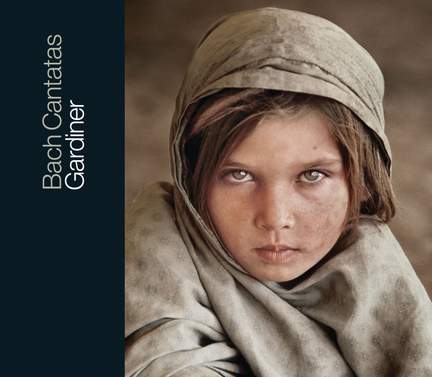
Bach Cantatas Volume 27
Cantatas for Whit Tuesday & Cantata for Trinity Sunday
Lisa Larsson, Nathalie Stutzmann, Christoph Genz, Stephen Loges, Ruth Holton, Daniel Taylor, Paul Agnew, Peter Harvey
The Monteverdi Choir & The English Baroque Soloists, John Eliot Gardiner
Awards:
-
BBC Music Magazine Awards, 2009, Choral Award Winner

These performances do full justice to such genius
Bach Cantatas Volume 27
Cantatas for Whit Tuesday & Cantata for Trinity Sunday
Lisa Larsson, Nathalie Stutzmann, Christoph Genz, Stephen Loges, Ruth Holton, Daniel Taylor, Paul Agnew, Peter Harvey
The Monteverdi Choir & The English Baroque Soloists, John Eliot Gardiner
Purchase product

We pay more royalties to artists and composers than any other streaming service with our innovative Fair Play pay-per-second model
We pay artists and composers fairly with our pay-per-second model
Awards:
-
BBC Music Magazine Awards, 2009, Choral Award Winner
These performances do full justice to such genius
About
Contents and tracklist
Erwünschtes Freudenlicht, BWV 184: Aria. Gesegnete Christen, gluckselige Herde (Soprano, Alto)
Track length8:17
Erwünschtes Freudenlicht, BWV 184: Recitative. So freuet euch, ihr auserwählten Seelen (Tenor)
Track length1:56
Erwünschtes Freudenlicht, BWV 184: Chorale. Herr, ich hoff je, du werdest die (Chorus)
Track length1:16
Er rufet seine Schafen mit Namen, BWV 175: Recitative. Er rufet seinen Schafen mit Namen (Tenor)
Track length0:25
Er rufet seine Schafen mit Namen, BWV 175: Aria. Es dunket mich, ich seh dich kommen (Tenor)
Track length3:07
Er rufet seine Schafen mit Namen, BWV 175: Recitative. Sie vernahmen aber nicht (Alto, Bass)
Track length1:05
Er rufet seine Schafen mit Namen, BWV 175: Aria. Öffnet euch, ihr beiden Ohren (Bass)
Track length4:19
Höchsterwünschtes Freudenfest, BWV 194: Recitative. Wie könnte dir, du höchstes Angesicht (Soprano)
Track length1:25
Höchsterwünschtes Freudenfest, BWV 194: Aria. Hilf, Gott, dass es uns gelingt (Soprano)
Track length5:33
Es ist ein trotzig und verzagt Ding, BWV 176: Es ist ein trotzig und verzagt Ding (Chorus)
Track length1:54
Es ist ein trotzig und verzagt Ding, BWV 176: Recitative. Ich meine, recht verzagt (Alto)
Track length0:42
Es ist ein trotzig und verzagt Ding, BWV 176: Aria. Dein sonst hell beliebter Schein (Soprano)
Track length2:58
Es ist ein trotzig und verzagt Ding, BWV 176: Recitative. So wundre dich, o Meister, nicht (Bass)
Track length1:27
Es ist ein trotzig und verzagt Ding, BWV 176: Aria. Ermuntert euch, furchtsam und schüchterne Sinne (Alto)
Track length2:20
O heiliges Geist- und Wasserbad, BWV 165: Aria. O heil'ges Geist- und Wasserbad (Soprano)
Track length3:31
O heiliges Geist- und Wasserbad, BWV 165: Recitative. Die sündige Geburt verdammter Adamserben (Bass)
Track length1:17
O heiliges Geist- und Wasserbad, BWV 165: Recitative. Ich habe ja, mein Seelenbräutigam (Bass)
Track length2:03
Awards and reviews

These performances do full justice to such genius
 2010
2010
The spread of locations – from Mühlhausen to Kirkwall – complements and intensifies the extraordinary range of cantatas in these rich and varied offerings from Sir John Eliot Gardiner.
Those who thought that, perhaps, the best fruits of the Pilgrimage had already been tasted, can think again with these two latest volumes.
One is reminded here – in works mainly for the extended summer months of the Trinity season – that the experience of touring so many masterpieces in such a short space of time obviated all dangers of homogeneity, comfort zones or complacency.
Some exhaustion and rough-edgedness, yes, and just occasionally there's not quite enough time for the performers to get under the skin of a particular work, yet such instances are impressively infrequent.
Gardiner and his forces rise here to each challenge (as the Pilgrimage had now passed the halfway point) with, it seems, a creative regimen of Bachian proportions: just as Bach efficiently identified how to react with supreme concentration and speed according to the compositional demands of the week, so these 21st-century performers adapt robustly to the seasonal implications within this pattern of ever-changing locales.
The proof is in the imagination and wide compass of these performances – objectively assessed after nearly eight years – where the intense archaic idioms of Aus der Tiefen (No 131) and the municipal bravura of Gott ist mein König (No 71), performed in the Mühlhausen church for which they were written, are accentuated in quiet, contemplative dignity and surface finery, respectively.
For Gardiner the emotional stakes are high and this possible memorial cantata for a horrific town fire is especially moving.
Bach's own engagement with a text or liturgical 'problem' depended largely on personal circumstances and this means that some cantatas make for challenging listening. Gardiner recognises this in his note for the austere Ein ungefärbtGemüte (No 24), where the Gospel paraphrase of 'ye would that men should do to you, do ye even so to them' is reflected in a fiddly chorus of contrapuntal finger-wagging, a caveat of hypocrisy which then implores us to constancy.
Gardiner is a master of delivering these hard enigmatic pieces with renewed logic and understanding, aided in No 185 by the fine duet of Magdalena KoOená and Paul Agnew and, then, alto Nathalie Stutzmann in the delectable 'Sei bemüht in dieser Zeit' (where the successful sower reaps a splendid harvest). This is, in fact, far from enigmatic but one of those courtly Weimar arias whose inimitable generosity of spirit, not least in its ordered periodic phrasing, requires assiduous refinement in voicing, which is exactly what the beautiful oboe-and-strings blend provides.
If the cantatas discussed this far are included in the unusually rich Vol 3, Vol 27 from Blythburgh and Kirkwall is only marginally less uniformly good. Both volumes are characterised by choral and instrumental contributions of the most imploring and thrilling extremes (for instance, the glowing chorus to No 177, Bach's provocative take on Marianne von Ziegler's text in No 176 and the ecstatic trumpetings of Gelobet, No 129).
Many of the arias for Whit Tuesday and Trinity Sunday comprise reused material from secular cantatas at Cöthen and hence the bright-eyed and bushy-tailed gavottes, minuets and bourrées, which appear regularly. Nothing better captures Bach's endless capacity for exuding inner succour than the luminous, gentle melodic contours of 'Was des Höchsten' (from No 194), although it's only one example in another treasure chest of cantatas, whose jewels continue to glisten for the new pilgrim-collectors.
 May 2008
Nothing better captures Bach's endless capacity for exuding inner succour than the luminous, gentle melodic contours of "Was des Höchsten" (from BWV194).