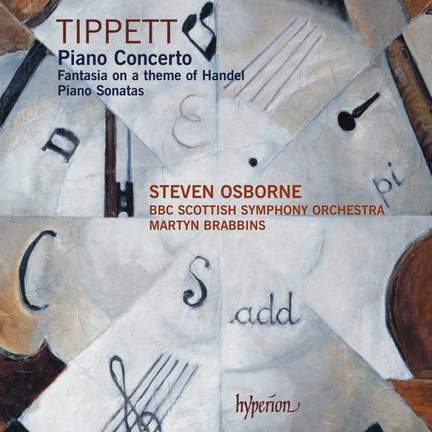
Tippett - The complete music for piano
Steven Osborne (piano)
BBC Scottish Symphony Orchestra, Martyn Brabbins
Awards:
-
BBC Music Magazine Awards, 2009, Instrumental Finalist

-
Gramophone Awards, 2008, Finalist - Concerto

-
BBC Music Magazine, January 2008, Instrumental Choice

-
Record Review, December 2007, Critics Disc of the Year

This splendid double album… assembles all Tippett's music for piano whether solo of with orchestra, in performances that impressively set new standards in these often challenging works.
Tippett - The complete music for piano
Steven Osborne (piano)
BBC Scottish Symphony Orchestra, Martyn Brabbins
Purchase product

Awards:
-
BBC Music Magazine Awards, 2009, Instrumental Finalist
-
Gramophone Awards, 2008, Finalist - Concerto
-
BBC Music Magazine, January 2008, Instrumental Choice
-
Record Review, December 2007, Critics Disc of the Year
This splendid double album… assembles all Tippett's music for piano whether solo of with orchestra, in performances that impressively set new standards in these often challenging works.
About
The musical and intellectual exuberance of Tippetts music is fully demonstrated in his piano works, recorded here in their entirety on a double CD. The sonatas and concertante works recorded here offer a more compact survey of the various stages of his composing career than any other of the traditional genres he favoured: symphony, opera, and string quartet. Every one of Tippetts six piano works is substantial, if not in length then in compositional ambition. By temperament he conceived music on a large scale and was more attracted to the sonata than the short genre piece typical of the famous pianist-composers of the 19th and 20th centuries. Being only a moderate pianist himself his piano writing speaks of an imagination directed not by virtuosity or routine movements of the fingers or the blandishments of the sustaining pedal but one set free to explore the contrapuntal style and fascination with rhythm it was heir to. This is full-blooded, dramatic, joyful music. Steven Osborne is a celebrated interpreter of Tippetts piano music, making the works his own and dealing with their considerable technical difficulties with ease and aplomb. In a recent interview with International Piano magazine, he wrote I cant think of any late 20th-century music that is more gripping to perform. He is joined by the BBC Scottish Symphony Orchestra under Martyn Brabbins.
Contents and tracklist
Awards and reviews
-
BBC Music MagazineJanuary 2008Instrumental Choice
-
Record ReviewDecember 2007Critics Disc of the Year
 January 2008
This splendid double album… assembles all Tippett's music for piano whether solo of with orchestra, in performances that impressively set new standards in these often challenging works.
 8th January 2008
This is full-blooded, dramatic, joyful music. Steven Osborne makes the works his own, dealing with their considerable technical difficulties with ease and aplomb...Under his fingers, the piano glitters and glides through the multi-faceted concerto with luminosity and depth, and his playing is perfectly matched by the BBC Scottish Symphony Orchestra under Martyn Brabbins.
 2010
2010
The young Tippett – magpie and maverick – sought maximum intensity of feeling while shunning what he felt to be the sentimental fervour of Elgar, Bax and Walton. Equally abhorrent were the pastoral pieties of Vaughan Williams. Tippett took his stand with Blake and Yeats rather than Bunyan, and a Blake whose 'bow of burning gold' required something altogether less complacent than Parry's well upholstered jingoism.
The results are plain to hear in Tippett's earliest works for piano, the First Sonata and the Handel Fantasia. The slow movement of the sonata may flirt briefly with Hindemith-style counterpoint but the predominant spirit is fiery and spontaneous, with a reinvigorated romanticism embracing those aspects of popular music which Tippett believed to have 'classical' potential.
The road ahead was bumpy and he occasionally lost his way, as in the very long slow movement of the Third Sonata, aspiring to Beethovenian depth but bogged down in overly dense textures. There are also several repetitions too many in the Fourth Sonata, though the final movement's gently poetic sense of resignation more than compensates.
Most powerful of all is the mighty Concerto, starkly and confidently poised between Tippett's still richly potent earlier style and the brave new possibilities explored in its visionary central movement. This recording blends the piano in with the orchestra, acknowledging the work's symphonic attributes, and there is a certain recessed quality to the sound of the piece throughout. Nevertheless, the eloquence and fantasy of what is undoubtedly one of the major works of the 1950s is superbly projected in a performance which need fear no comparison with the best earlier recordings. As for the sonatas, Steven Osborne is at least the equal of Paul Crossley (CRD) in interpretative empathy, and has the advantage of superlative modern recording.
There's a further advantage: perceptive and lucid booklet-notes by Ian Kemp, Tippett's friend and biographer, and one of Osborne's mentors. The set is dedicated to him.
 December 2007
Most powerful of all is the mighty Concerto… the eloquence and fantasy of what is undoubtedly one of the major works of the 1950s is superbly projected in a performance which need fear no comparison with the best earlier recordings… As for the sonatas, Steven Osborne is at least the equal of Paul Crossley... in interpretative empathy, and has the advantage of superlative modern recording.

This double album is a monumental achievement. Tippett’s writing for piano is as demanding as it is cliché-resistant. No body of music for the instrument since Messiaen’s is as distinctive as his and it is wonderful to have the oeuvre together on disc. The concerto is realised with a precision and vigour, both soloistic and orchestral, that leave one marvelling anew at its inventiveness. The account of the brief, early, concerted Fantasia on a theme of Handel makes me revise my opinion of the work sharply upwards. In Osborne’s account of the four sonatas, each a big statement, radiance and virtuosity go hand in hand

Osborne is superb at delineating the characters of the four sonatas and underlining how, in their very different ways, they relate to the piano tradition … under his fingers the Second Sonata emerges as a gritty and uncompromising masterpiece … his account of the Piano Concerto with Martyn Brabbins and the BBC Scottish Symphony is similarly charged