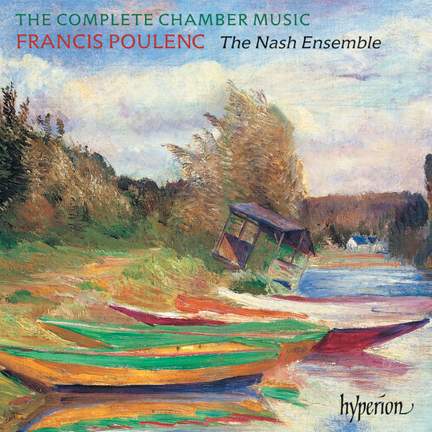
Poulenc - The Complete Chamber Music
The Nash Ensemble
Invidious as it may seem to pick out just one of these excellent artists, special mention must be made of Ian Brown, who plays in nine of the 13 works included and confirms his standing as one...
Poulenc - The Complete Chamber Music
The Nash Ensemble
Purchase product

Invidious as it may seem to pick out just one of these excellent artists, special mention must be made of Ian Brown, who plays in nine of the 13 works included and confirms his standing as one...
About
This collection of the complete chamber music of Poulenc shows the varying styles that he employed. From the jazzy, bitonal passages of the Sonata for Clarinet and Bassoon and the Sonata for Horn, Trumpet and Trombone which has been described as 'Pergolesi with his wig awry' (Roger Nichols, Grove) to the profound beauty of his last three sonatas for wind. All are extremely accessible. The Nash Ensemble gave a series of concerts of Poulenc's music at the Wigmore Hall earlier this year to great critical acclaim and Hyperion are delighted to be able to present this wonderful collection on this, Poulenc's centenary year.
Contents and tracklist
Spotlight on this release
-
An error occurred.
Try watching this video on www.youtube.com, or enable JavaScript if it is disabled in your browser.
-
Francis Poulenc
21st Nov 2014
Katherine selects some favourite recordings of the French composer Francis Poulenc.

Awards and reviews
 2010
2010
Invidious as it may seem to pick out just one of these excellent artists, special mention must be made of Ian Brown, who plays in nine of the 13 works included and confirms his standing as one of the most admired and musicianly chamber pianists of our day. He knows, for example, how to control Poulenc's boisterous piano writing in the Sextet without sacrificing the sparkle, and as a result the work coheres better than ever before. Like the Trio (whose opening reveals Stravinskian influence), it's a mixture of the composer's madcap gamin mood and his predominantly melancholy bittersweet lyricism.
The latter characteristic is most in evidence in his most enduring chamber works: the solo wind sonatas with piano, all three of which were in the nature of tombeaux , the Flute Sonata for the American patron Mrs Sprague Coolidge, that for clarinet for Honegger, and that for oboe for Prokofiev. All are given idiomatic, sensitive and satisfying performances by the Nash artists.
The Elégie for Dennis Brain was a not altogether convincing experiment in dodecaphony: Poulenc had earlier dabbled in atonality and polytonality in the little sonatas (really sonatinas) for, respectively, two clarinets and for clarinet and bassoon. There's a touching reading of the little Sarabande for guitar. A hint of the guitar's tuning at the start of the second move- ment is almost the only Spanish reference in the Violin Sonata, which was composed in memoriam the poet Lorca, whose loss is bitterly suggested in the angry finale. In this work Poulenc allotted to the piano (his own instrument) rather more than equal status in the duo – a situation rather paralleled in the lighthearted Cello Sonata, over which the composer dallied longer than any other of his works – but balance in both is finely judged by the performers and the recording team.
The whole issue wins enthusiastic recommendation: it bids fair to become the undisputed yardstick for the future.
 21st November 2014
A superb two-disc overview of the sonatas and larger ensemble-works from The Nash Ensemble here, with pianist Ian Brown doing particularly sterling work; Philippa Davies's pellucid account of the Flute Sonata is an especial highlight.