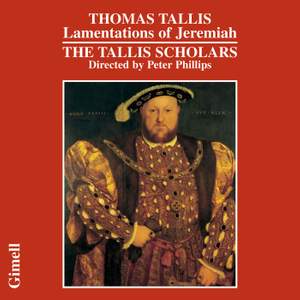


Offer,Tallis - Lamentations of Jeremiah
The Tallis Scholars, Peter Phillips
This, the third volume of the survey by The Tallis Scholars of the music of the Tudor composer, Thomas Tallis, contains the well-known Lamentations, eight motets, and the extended motet Salve... — More…
CD
Original price ($15.75) Reduced price $12.75Downloads
What are FLAC and MP3?Contents
Tallis: Lamentations of Jeremiah I
Work length8:57
$1.60
$1.95
- The Tallis Scholars
- Peter Phillips
Tallis: Lamentations of Jeremiah II
Work length13:13
$2.15
$2.60
- The Tallis Scholars
- Peter Phillips
Tallis: Absterge Domine
Work length6:10
$1.05
$1.30
- The Tallis Scholars
- Peter Phillips
Tallis: Derelinquat impius
Work length3:53
$1.05
$1.30
- The Tallis Scholars
- Peter Phillips
Tallis: Mihi autem nimis
Work length2:35
$1.05
$1.30
- The Tallis Scholars
- Peter Phillips
Tallis: O sacrum convivium
Work length3:38
$1.05
$1.30
- The Tallis Scholars
- Peter Phillips
Tallis: In ieiunio et fletu
Work length4:31
$1.05
$1.30
- The Tallis Scholars
- Peter Phillips
Tallis: O salutaris hostia for five voices
Work length3:01
$1.05
$1.30
- The Tallis Scholars
- Peter Phillips
Tallis: In manus tuas
Work length2:06
$1.05
$1.30
- The Tallis Scholars
- Peter Phillips
Tallis: O nata lux de lumine
Work length2:02
$1.05
$1.30
- The Tallis Scholars
- Peter Phillips
Tallis: Salve intemerata
Work length17:26
Album only
Album only
- The Tallis Scholars
- Peter Phillips