The Romantic Violin Concerto 1 - Saint-Saëns
Philippe Graffin (violin)
BBC Scottish Symphony Orchestra, Martyn Brabbins
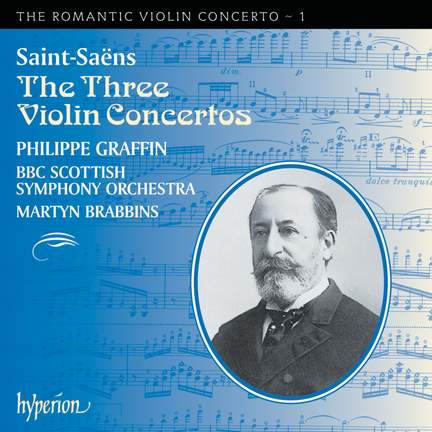
The first two violin concertos of Saint-Saëns were composed in reverse order. The Second is the longer and lesser-known of the two, but the First Concerto more resembles the thematic charm and...
The Romantic Violin Concerto 1 - Saint-Saëns
Philippe Graffin (violin)
BBC Scottish Symphony Orchestra, Martyn Brabbins
Purchase product

The first two violin concertos of Saint-Saëns were composed in reverse order. The Second is the longer and lesser-known of the two, but the First Concerto more resembles the thematic charm and...
About
These sparkling performances of Saint-Saens' violin concertos are a fitting start to Hyperion's new series of Romantic Violin Concertos; a follow on from the highly successful Romantic Piano Concerto series. Saint-Saens C Major concerto resembles Mendelssohn's great violin concerto. Both are declamatory, extravagant in character, highly lyrical and immediately establish the soloist as a romantic protagonist. Though more conventional, the violin writing for the Concerto in A Major is ever-inventive, especially in the witty second episode where the hen from Le Carnaval des Animaux makes a premature entrance. This was the first of several works he composed for the great Spanish violinist Pablo de Sarasate; in 1859 just fifteen years old but already a famous virtuoso. Saint-Saens' instantly memorable melodies are a feature of all his best-known works, and there are tunes in abundance in the well-known B Minor Concerto. The intense B minor mood probably offered inspiration for the violin concertos of Elgar and Bartok.
Contents and tracklist
Awards and reviews
 2010
2010
The first two violin concertos of Saint-Saëns were composed in reverse order. The Second is the longer and lesser-known of the two, but the First Concerto more resembles the thematic charm and concise design of the First Cello Concerto. Cast in a single short movement that falls into three distinct sections, it launches the soloist on his way right from the start, and features a delightful central section with some felicitous woodwind writing. Hyperion holds a trump card in Philippe Graffin, whose elegant, emotionally charged playing is strongly reminiscent of the young Menuhin, and whose understanding of the idiom is second to none – certainly among modern players.
Saint-Saëns's First Violin Concerto was composed in 1859, whereas his Second preceded it by a year. Unexpectedly, the first movement's thematic material has an almost Weberian slant. The orchestration is heavier than in the First, and the musical arguments are both more formal and more forcefully stated. It's a more overtly virtuoso work than the First Concerto, and perhaps rather less memorable, but again Graffin weaves a winsome solo line and Martyn Brabbins directs a strong account of the orchestral score, with prominently projected woodwinds. The relatively well-known Third Concerto (1880) is roughly the same length as the Second (around half an hour), but is more consistently interesting. The basic material is of higher quality, the key relations more telling and orchestration infinitely more delicate. No other recording liberates so much of the score's instrumental detail, probably because most of Graffin's predecessors have been balanced way in front of the orchestra.
 2011 edition
Graffin, with rich firm tone, gives performances full of temperament, warmly supported by Martin Brabbins and the BBC Scottish Symphony Orchestra, and the recording cannot be faulted.