Schubert - Piano Sonatas
Stephen Hough (piano)
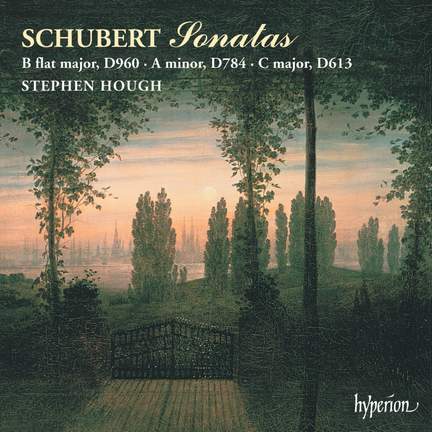
Hough's sensitive performances of Schubert's deceptively plain-speaking late sonatas bring out their Classical grace and structural rigour.
Schubert - Piano Sonatas
Stephen Hough (piano)
Purchase product

We pay more royalties to artists and composers than any other streaming service with our innovative Fair Play pay-per-second model
We pay artists and composers fairly with our pay-per-second model
Hough's sensitive performances of Schubert's deceptively plain-speaking late sonatas bring out their Classical grace and structural rigour.
About
Schubert's Piano Sonatas, after a century of neglect, are now regarded as being among the most profound musical works ever written. Here Stephen Hough tackles the last, perhaps the greatest, of themD960in a performance of extraordinary depth and beauty. Also included on this well-filled are the earlier masterpiece, D784, and the almost unknown D613 Unfinished Sonata which nonetheless contains much vintage Schubert and some wildly experimental writing. Though entering a highly competitive field, this disc has nothing to fear from its rivals; these are performances sure to join the ranks of the very greatest.
Contents and tracklist
Awards and reviews
 June 2008
Hough's sensitive performances of Schubert's deceptively plain-speaking late sonatas bring out their Classical grace and structural rigour.
 2010
2010
Stephen Hough's moving performance of D960 is marked throughout by refined, discerning pianism and an uncommonly subtle ear for texture.
In all four movements, he seeks out the music's inwardness and fragility, its ethereal, self-communing remoteness. The opening Molto moderato, unfolding in vast, calm spans, has a hypnotic inevitability; there are countless felicities of timing and colour, but always a vital sense of forward motion. Hough adopts a dangerously slow tempo in the Andante but sustains it through the breadth and concentration of his line, the subtlety of his tonal palette and his pointing of rhythmic detail. His rarefied grace and delicacy, his gentle probing of the music's vulnerability, are of a piece with his conception of the sonata as a whole.
As usual, Hyperion doesn't stint over playing time, offering another complete sonata in addition to the two-movement fragment, D613.
D784, perhaps Schubert's most depressive instrumental work, is magnificently done.
Hough distils an immense weight of suffering from the pervasive two-note motif that dominates the first movement like some massive, Wagnerian pendulum; but, typically, the lyrical music is limpidly coloured and poignantly inflected, with an unusually precise observation of Schubert's accents. The Andante is flowing and long-arched, with some ravishing soft play- ing, and he a brings a superb rhythmic impulse to the eerily scudding counterpoint of the main subject and a piercing tenderness to the contrasting F major theme. The fragmentary C major Sonata, D613, one of numerous Schubert torsos from the years 1817-22, is no great shakes: two pleasant but uneventful movements, both incomplete. The recording is of exemplary clarity, warmth and truthfulness.