
Help
Skip to main content

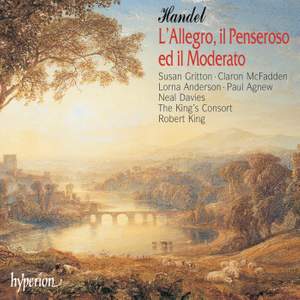
Handel: L'Allegro, il Penseroso ed il Moderato

Susan Gritton, Claron McFadden, Lorna Anderson, Paul Agnes, Neal Davies

The King's Consort, Robert King

Handel: L'Allegro, il Penseroso ed il Moderato
This is the first truly complete recording of Handel's delectable pastoral ode. The early numbers of L'Allegro – literally 'the cheerful man' – have a spontaneous exuberance barely matched in...

Handel: L'Allegro, il Penseroso ed il Moderato

Susan Gritton, Claron McFadden, Lorna Anderson, Paul Agnes, Neal Davies

The King's Consort, Robert King

Purchase product

2 CDs

$24.50

In stock - only 33 left: usually despatched within 1 working day

Download

From$12.50

Download

Audio formats guide

44.1 kHz, 16 bit, FLAC/ALAC/WAV

$18.75

320 kbps, MP3

$12.50

This release includes a digital booklet

Stream now lossless, 44.1 kHz, 16 bit
This is the first truly complete recording of Handel's delectable pastoral ode. The early numbers of L'Allegro – literally 'the cheerful man' – have a spontaneous exuberance barely matched in...

About

After the success of Alexander's Feast, a setting of the much admired ode by John Dryden, it was wondered: would the result be greater still if Handel could be persuaded to set the words of a poet even greater than Dryden? Such were the thoughts of an important group of Handel's friends centred around the philosopher James Harris and including Charles Jennens (later the librettist of Messiah) and the Fourth Earl of Shaftesbury. It was under their influence that Handel came to set the poetry of John Milton, first in L'Allegro, il Penseroso ed il Moderato, and later in the oratorio Samson. Jennens helped to prepare the libretto for L'Allegro, the first two parts of which are adapted from Milton's two complementary poems, L'Allegro ('The Merry Man') and Il Penseroso ('The Thoughtful Man'), respectively celebrating the different joys of two opposed personalities. The initial idea of interweaving lines from the two poems to make a text for musical setting actually came from James Harris, who also provided the first draft of the libretto. By 19 January 1740 the libretto was finished, and with Handel's enthusiasm and speed in writing the first performance took place on 27 February! There is no definitive version of the work as Handel made many changes over time. However, the intention of this perfomance is to retain the freshness of Handel's original vision with the advantage of the best of his second thoughts.

Contents and tracklist

Part 1 No 01. Accompagnato. Hence, loathed melancholy (L'Allegro)
Track length3:14
Part 1 No 02. Accompagnato. Hence, vain deluding joys (Il Penseroso)
Track length0:57
Part 1 No 03. Air. Come, thou goddess fair and free (L'Allegro)
Track length1:30
Part 1 No 04. Air. Come rather, goddess, sage and holy (Il Penseroso)
Track length3:33
Part 1 No 05. Air with chorus. Haste thee, nymph, and bring with thee (L'Allegro)
Track length2:22
Part 1 No 06. Air with chorus. Come and trip it as you go (L'Allegro)
Track length2:47
Part 1 No 07. Accompagnato. Come, pensive nun, devout and pure (Il Penseroso)
Track length1:09
Part 1 No 08. Air. Come, but keep thy wonted state (Il Penseroso)
Track length1:40
Part 1 No 09. Accompagnato with chorus. There, held in holy passion still (Il Penseroso)
Track length4:49
Part 1 No 10. Recitative. Hence, loathed Melancholy! (L'Allegro)
Track length0:29
Part 1 No 11. Air. Mirth, admit me of thy crew (L'Allegro)
Track length3:39
Part 1 No 12. Accompagnato. First and chief, on golden wing (Il Penseroso)
Track length0:49
Part 1 No 13. Air. Sweet bird, that shun'st the noise of Folly (Il Penseroso)
Track length14:35
Part 1 No 14. Recitative. If I give thee honour due (L'Allegro)
Track length0:10
Part 1 No 15. Air. Mirth, admit me of thy crew (L'Allegro)
Track length2:35
Part 1 No 16. Air. Oft on a plat of rising ground (Il Penseroso)
Track length4:02
Part 1 No 17. Air. Far from all resort of mirth (Il Penseroso)
Track length3:36
Part 1 No 18. Recitative. If I give thee honour due (L'Allegro)
Track length0:15
Part 1 No 19. Air. Let me wander not unseen (L'Allegro)
Track length2:23
Part 1 No 20. Air. Straight mine eye hath caught new pleasures (L'Allegro)
Track length2:28
Part 1 No 21. Accompagnato. Mountains, on whose barren breast (L'Allegro)
Track length1:46
Part 1 No 22. Air with chorus. Or let the merry bells ring round (L'Allegro)
Track length4:40
Part 2 No 01. Accompagnato. Hence, vain deluding Joys (Il Penseroso)
Track length1:16
Part 2 No 02. Air. Sometimes let gorgeous tragedy (Il Penseroso)
Track length4:01
Part 2 No 03. Air. But O, sad virgin, that thy pow'r (Il Penseroso)
Track length6:49
Part 2 No 04. Air. Thus, Night, oft see me in thy pale career (Il Penseroso)
Track length0:19
Part 2 No 05. Chorus. Populous cities please me then (L'Allegro)
Track length3:31
Part 2 No 06. Air. There let Hymen oft appear (L'Allegro)
Track length2:08
Part 2 No 07. Accompagnato. Me, when the sun begins to fling (Il Penseroso)
Track length0:49
Part 2 No 08. Air. Hide me from Day's garish eye (Il Penseroso)
Track length3:27
Part 2 No 09. Air. I'll to the well-trod stage anon (L'Allegro)
Track length2:00
Part 2 No 10. Air. And ever against eating cares (L'Allegro)
Track length2:51
Part 2 No 11. Air. Orpheus' self may heave his head (L'Allegro)
Track length2:30
Part 2 No 12. Air with chorus. These delights if thou canst give (L'Allegro)
Track length3:16
Part 2 No 13. Recitative. But let my due feet never fail (Il Penseroso)
Track length0:39
Part 2 No 14. Chorus. There let the pealing organ blow (Il Penseroso)
Track length2:21
Part 2 No 15. Air. May at last my weary age (Il Penseroso)
Track length4:07
Part 2 No 16. Fugue. Organo ad libitum il soggetto della fuga seguente
Track length1:18
Part 2 No 17. Chorus. These pleasures, Melancholy, give (Il Penseroso)
Track length5:06
Part 3 No 1. Accompagnato. Hence! boast not, ye profane (Il Moderato)
Track length0:32
Part 3 No 2. Air. Come, with native lustre shine (Il Moderato)
Track length3:16
Part 3 No 3. Accompagnato with chorus. Sweet Temp'rance in thy right hand bear (Il Moderato)
Track length2:47
Part 3 No 4. Air. Come, with gentle hand restrain (Il Moderato)
Track length1:45
Part 3 No 5. Recitative. No more short life they then will spend (Il Moderato)
Track length0:46
Part 3 No 6. Air. Each action will derive new grace (Il Moderato)
Track length2:16
Part 3 No 7. Duet. As steals the morn upon the night (Il Moderato)
Track length7:28
Part 3 No 8. Chorus. Thy pleasures, Moderation, give (Il Moderato)
Track length3:29

Awards and reviews

2010

This is the first truly complete recording of Handel's delectable pastoral ode. The early numbers of L'Allegro – literally 'the cheerful man' – have a spontaneous exuberance barely matched in Handel's output, while much of the music of Il penseroso ('The melancholy man') attains a contemplative ecstasy found elsewhere only in parts of Theodora. The whole work is suffused with an almost pantheistic sense of wonder and delight in the natural world. While alive to the al fresco gaiety of numbers such as 'Mirth, admit me of thy crew' and 'O let the merry bells', Robert King gives full value to the tranquil reflectiveness that lies at the core of the work, favouring broad tempos and gravely expressive phrasing. Occasionally, as in the soprano aria 'Straight mine eye hath caught new pleasures', his approach seems a shade too reverential.
But for the most part he directs this glorious music with affection and relish, abetted by vivid orchestral playing and a typically responsive contribution from the chorus.
Susan Gritton is a soprano of rare accomplishment, with a warm, pure, yet highly individual timbre and a wonderful feeling for the broad Handelian line. Both the scena 'Come pensive nun' and the romantic nocturne 'Oft on a plat of rising ground', with its haunting evocation of 'the far-off curfew', are intensely moving; and, with the cellist Jane Coe, she makes an eloquent case for the long florid aria 'But O! sad virgin', omitted in the Gardiner recording. Lorna Anderson, if a mite less secure above the stave, brings an appealing plangent tone to the nightingale aria 'Sweet bird' (done complete here, whereas Gardiner makes drastic cuts) and a trancelike absorption to the sublime 'Hide me from Day's garish eye'. Some slightly odd vowel sounds apart, Claron McFadden's bright, eager tones and nimble coloratura serve the more extrovert arias well; Neal Davies is sturdy in his bucolic hunting number and mellifluous in his minuet aria in Il moderato; and Paul Agnew is personable and stylish, though his legato is rather shown up by Susan Gritton's in 'As steals the morn'.
View download progress